Nissan 350Z: The Rebirth of the Z Dynasty

Specifications
Basic Information
Performance & Value
From the Datsun 240Z to the Modern Naturally Aspirated V6
At the turn of the millennium, Nissan embarked on an ambitious industrial turnaround spearheaded by the Nissan Revival Plan. Among its flagship projects was the contemporary reinvention of the 1969 Datsun 240Z, the foundational icon of the Z-car lineage.
The engineering brief prioritized a proven, timeless recipe: a dedicated two-seater sports coupe, a well-balanced rear-wheel-drive platform, a large-displacement naturally aspirated six-cylinder engine, and aggressive pricing aimed squarely at established European benchmarks. Unveiled in late 2002 and launched across Europe in the autumn of 2003, the Nissan 350Z (chassis code Z33) achieved roughly 250,000 units produced over its seven-year production run, marking Nissan’s triumphant and lasting return to the international sports car stage.
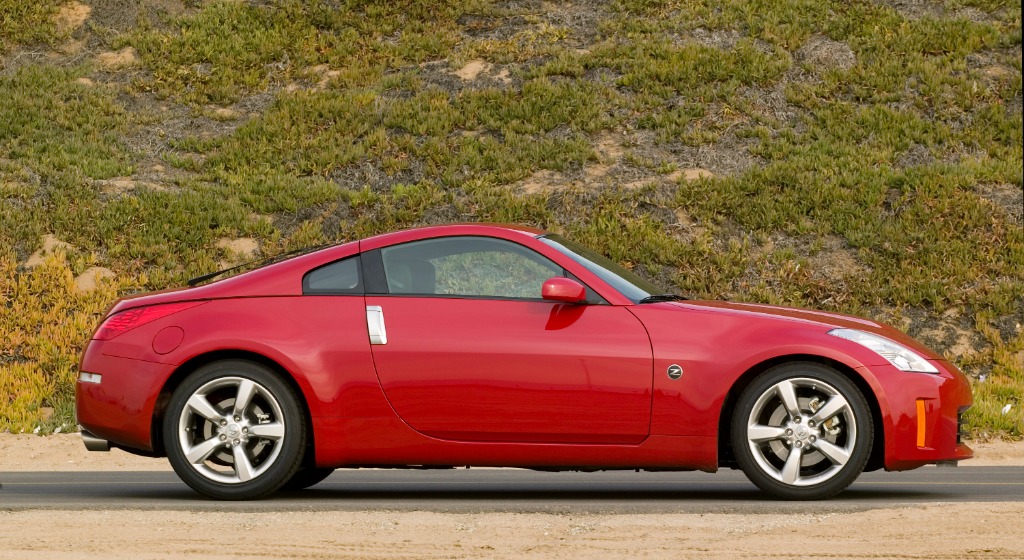
The Nissan 350Z Coupe: clean fastback profile and vertical aluminum door handles. The featured example is the special 35th Anniversary edition (2005) finished in Redline red, factory-equipped with specific 18-inch wheels and Brembo brakes.
Source: © Nissan Motor Co.
Market Context and Global Distribution
To understand where the 350Z stands today on the modern classic market, it is essential to examine how production was distributed and the equipment differences across regions:
1. North America: The Primary Commercial Engine (60% of Production)
The North American market was the top priority of the Z33 program. With nearly 150,000 units sold in the United States alone, the car was met with widespread commercial and critical acclaim:
- Aggressive Pricing: Starting below $30,000 at its 2002 launch, the 350Z offered 287 hp with a massive price advantage over contemporary Porsche Boxsters or BMW Z4s with comparable output. Over 36,000 units were delivered in 2003 alone.
- US Model Nuances: A broad trim structure (Base, Enthusiast, Touring, Track, Grand Touring), a high percentage of 5-speed automatic transmissions (nearly 60% of sales), and strong customer uptake for the Roadster variant.
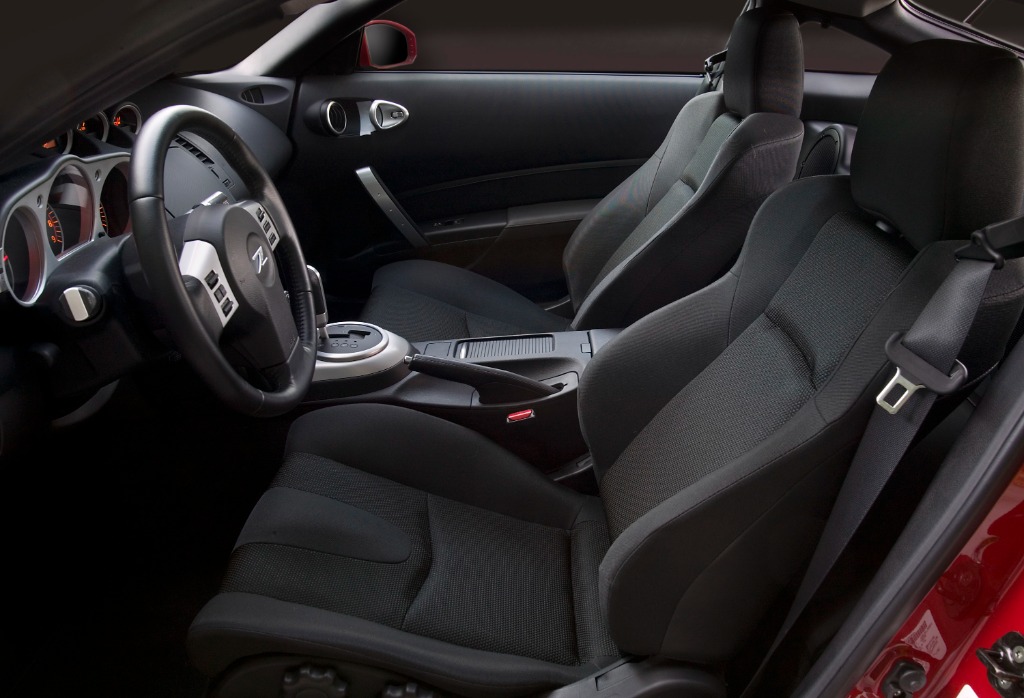
US market nuance: a significant share of 350Zs sold in North America were ordered with a 5-speed automatic transmission and cloth upholstery, whereas European models were delivered standard with a 6-speed manual gearbox.
Source: © Nissan Motor Co.
2. Japan: The “Fairlady Z” (15% of Production)
In its domestic market, the car proudly retained its heritage Fairlady Z badge. Initially assembled at Oppama and subsequently at the Tochigi manufacturing plant (dedicated to Nissan’s flagship rear-wheel-drive sedans and coupés), it served as the competition platform for official factory efforts in the Super GT championship (JGTC). In Japan, NISMO developed specialized variants, including the Type E homologation special and the ultra-exclusive NISMO 380RS (a 3.8-liter naturally aspirated screamer pushing 350 hp, limited to just 300 units).
3. Europe and France: High-Specification Standard Equipment (15% of Production)
For the European market, Nissan adopted a concentrated trim strategy with generous standard equipment:
- Standard Performance Hardware: European models came equipped standard with the sport suspension pack, fixed 4-piston Brembo front calipers, viscous limited-slip differential (VLSD), and the 6-speed manual gearbox. The optional Pack added heated leather seats and a premium Bose sound system.
- Price-to-Performance Benchmark: Introduced around €35,000 in France in 2003, the 350Z delivered straight-line acceleration and lateral grip on par with German sports coupés priced substantially higher.
- The French Market: Approximately 2,500 new units were registered in France throughout the model’s lifespan. Early 280 hp coupés represent the majority of survivor cars, whereas the final 313 hp HR models (2007–2009) remained exceedingly rare, with fewer than 300 units delivered nationwide across coupés and roadsters combined.
4. Cultural Footprint and Pop Culture Stardom
The 350Z enjoyed massive visibility among the generation of driving enthusiasts who came of age in the 2000s:
- Video Game Hero: An undisputed star in seminal driving titles such as Need for Speed: Underground 2 (2004) and the Gran Turismo franchise. In 2005, Nissan produced an official numbered limited run: the 350Z Gran Turismo 4 Edition.
- Cinema and Pop Culture: Cast in prominent roles including The Fast and the Furious: Tokyo Drift (2006), the Z33 became one of the most instantly recognizable Japanese automotive silhouettes of the decade.
Design: A Clean and Purposeful Silhouette
Supervised by Shiro Nakamura and penned at Nissan Design America under the direction of Ajay Panchal, the 350Z is distinguished by the clarity and muscularity of its surfacing:
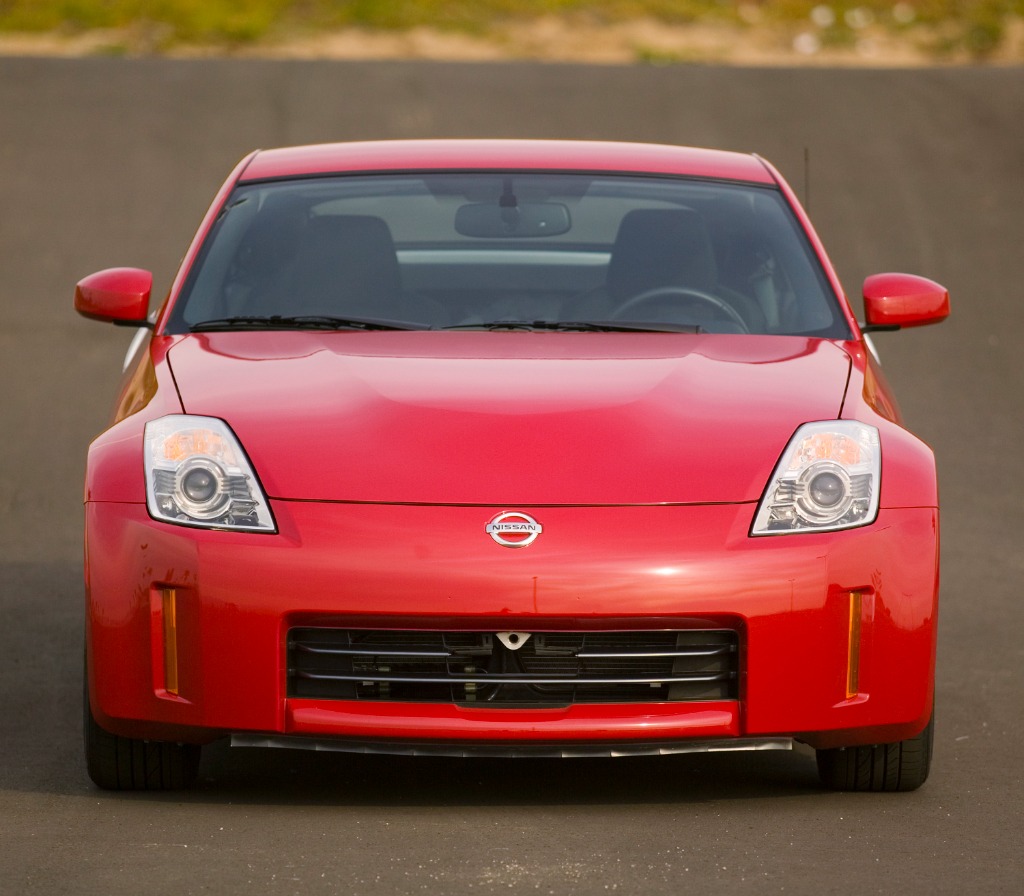
Front end of the 35th Anniversary edition in Redline red: minimalist rectangular grille and headlamps swept cleanly into the fenders, free from gratuitous appendages.
Source: © Nissan Motor Co.
1. Proportions and Signature Styling Cues
The Z33 styling emphasizes fluid volumes and strict geometric balance:
- Continuous Fastback Roofline: The roof slopes unbroken down into the rear decklid, creating a taut, compact silhouette.
- Short Overhangs: The wheels are pushed out to the four corners on a 104.3-inch (2,650 mm) wheelbase, promoting cornering stability and composure.
- Model Hallmarks:
- Vertical Brushed Aluminum Door Handles: Sculpted flush into the bodywork, they remain an unmistakable trademark of the Z33 generation.
- Tapered Lighting Units: Almond-shaped headlamps up front matched with sharp triangular taillights at the rear.
- Central Hood Power Bulge (on HR models from 2007 onwards): Designed to clear the taller twin-intake runners and dual throttle bodies, this bulge pays direct visual homage to the hood of the original 1969 Datsun 240Z.
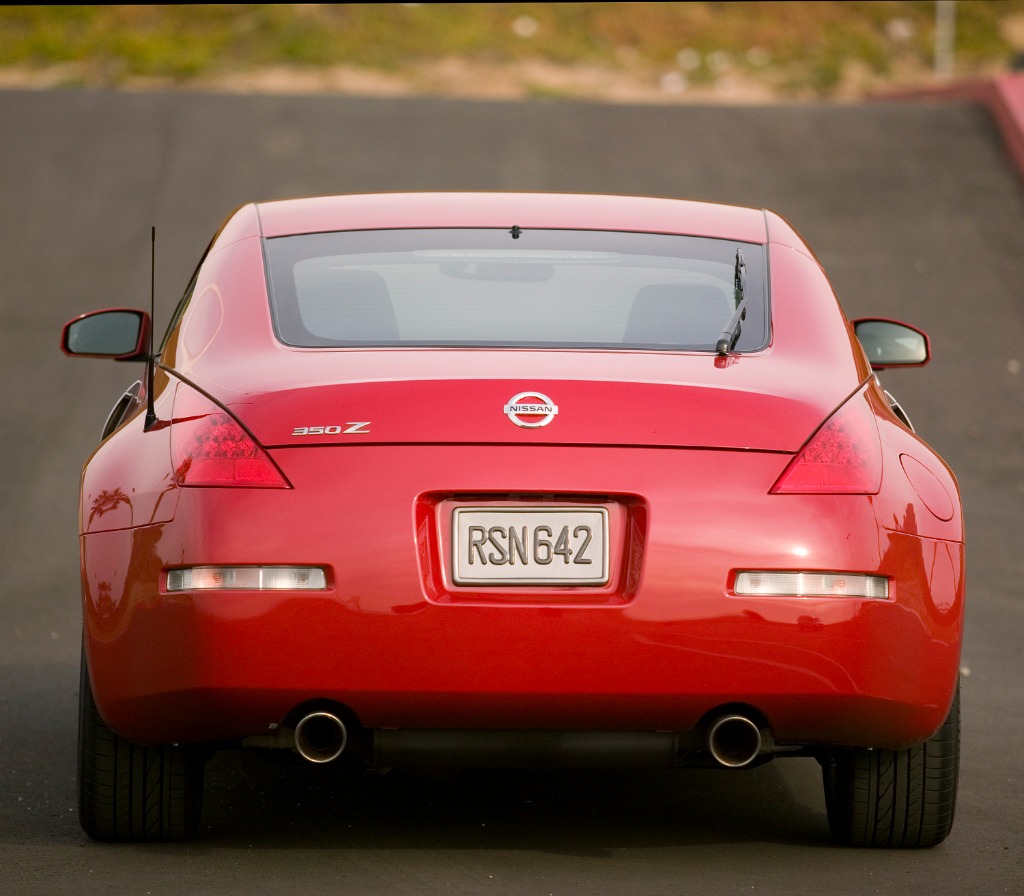
Rear view of the 35th Anniversary edition: broad haunches, vertical triangular taillights, and factory dual exhaust outlets.
Source: © Nissan Motor Co.
2. Evolution of Collector Sentiment
Between 2005 and 2015, low entry prices on the second-hand market led many owners to install aftermarket body kits, oversized spoilers, and slammed coilover setups. Today, collector and enthusiast interest has shifted firmly back toward strictly stock condition. Sitting on factory alloy wheels (especially the lightweight 18-inch forged RAYS 5-spoke wheels) and wearing period-correct colors (Silverstone Metallic, Super Black, or Sunset Orange), the original lines of the Z33 have aged gracefully into modern classic status.
Cockpit and Ergonomics
The interior layout clearly reflects Nissan’s development priorities: investing the budget into mechanical components (engine, suspension geometry, Brembo brakes) while delivering a cockpit centered around the driver.
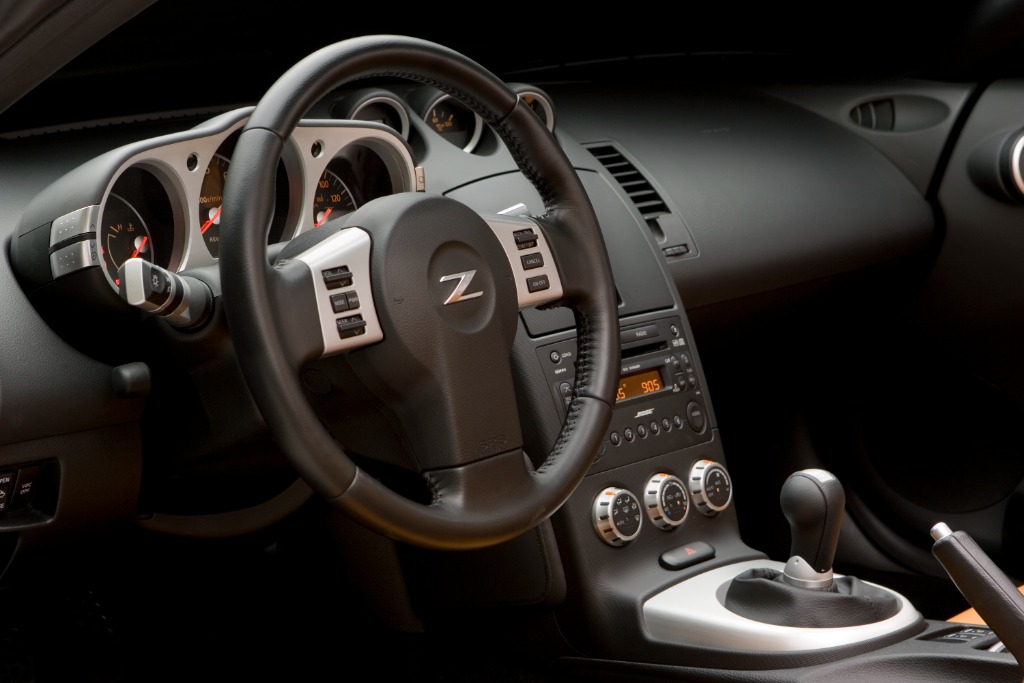
Driver-centric cockpit: instrument cluster tilting in unison with the steering column, three-spoke Z steering wheel, and short manual gear lever.
Source: © Nissan Motor Co.
1. Driving Position and Instrumentation
The ergonomics are tailored for high-performance driving:
- Triple Auxiliary Gauges: Canted toward the driver at the top of the center stack (multifunction trip computer/speedometer, oil pressure, voltmeter), evoking the historic layout of the 240Z.
- Integrated Steering Column and Gauge Pod: When adjusting the steering wheel for tilt, the entire instrument pod moves with it, ensuring the tachometer is never blocked by the wheel rim.
- Low-Slung Seating: Low hip-point, raised transmission tunnel, and drilled aluminum pedals.
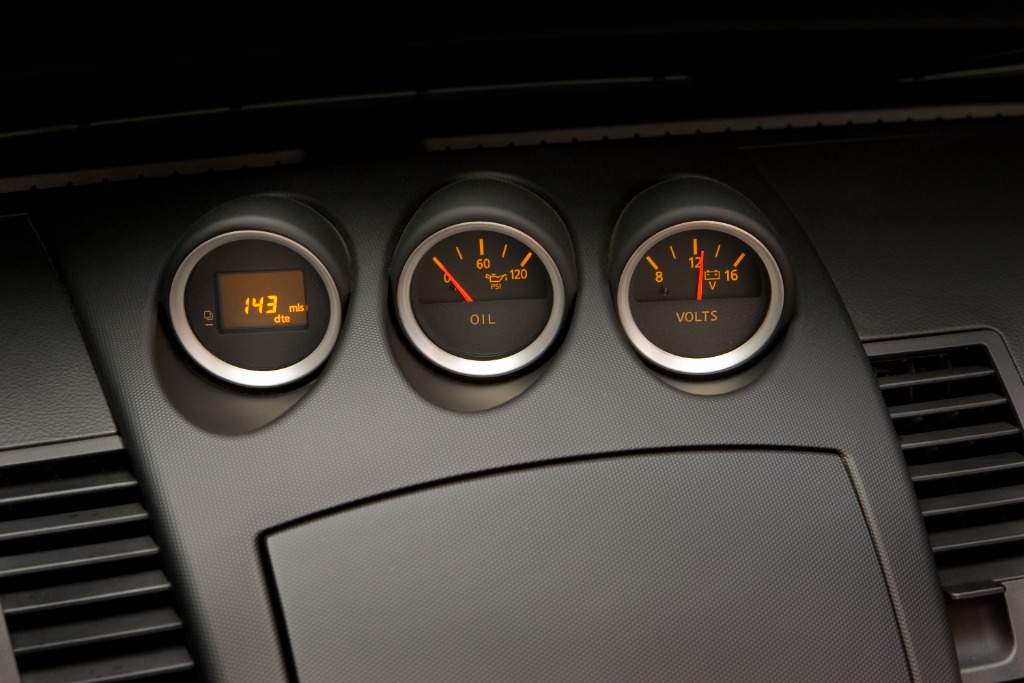
The three driver-oriented auxiliary dials: multifunction trip display, oil pressure gauge, and voltmeter.
Source: © Nissan Motor Co.
2. Phase 1 Soft-Touch Plastic Aging (2002–2005)
- Rubberized Soft-Touch Coating (2002–2005): The center waterfall console, gauge bezel surrounds, and interior door grab handles were treated with a matte rubberized coating. Under heat and fingernail contact, this coating tends to scratch and peel.
- Phase 2 and Phase 3 Revisions (late 2005–2009): Nissan redesigned the door cards (incorporating bottle holders), added knurled aluminum rotary HVAC knobs, and upgraded interior surface durability.
[!TIP] Restoring Phase 1 Interior Plastics:
- Remove the center console, door handles, and gauge surrounds (straightforward disassembly in about 30 minutes).
- Strip off the deteriorated rubberized layer using a microfiber towel soaked in isopropyl alcohol (avoid acetone at all costs, as it dissolves ABS plastic).
- Wet sand the plastic using 800-grit, then 1,000-grit abrasive paper.
- Apply a plastic adhesion promoter primer followed by a durable satin black automotive interior trim paint. The result returns the cockpit to an immaculate, factory-clean look that resists future scratches.
3. Structural Rear Strut Brace and Cargo Space
Across the rear cargo compartment, Nissan engineered a substantial aluminum cross-car strut tower brace. While this structure contributes significantly to torsional stiffness, it cuts into usable luggage depth. A helpful diagram located under the rear hatch demonstrated how to fit two golf bags around the crossbar.
The Roadster (2003–2009)
Introduced shortly after the coupé and launched in Europe in the spring of 2005, the open-top Roadster replaces the fixed metal roof with an electro-mechanical fabric top that stows cleanly underneath a flush-fitting, sculpted tonneau cover in about 20 seconds.
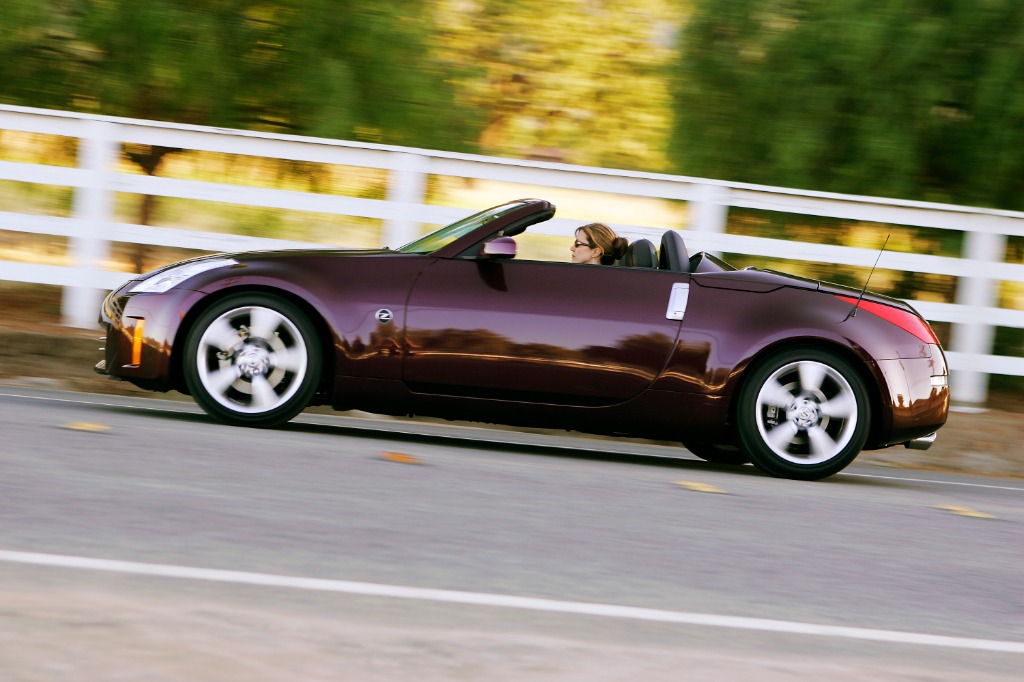
The Roadster version: allows drivers to experience the full acoustic character of the naturally aspirated VQ35 V6 under the open sky.
Source: © Nissan Motor Co.
1. Technical Nuances
- Added Weight (+242 lbs / +110 kg): To compensate for the structural absence of a fixed roof, Nissan reinforced the rocker panels, A-pillars, and rear bulkhead. The Roadster checks in at approximately 3,615 lbs (1,640 kg).
- Ride and Handling: Slightly more compliant suspension tuning makes the Roadster a refined grand touring cruiser for scenic backroads rather than a track-day weapon.
- 4.6 cu ft (130-liter) Trunk: Modest capacity, but completely free from the coupé’s intrusive cross-car strut tower bar.
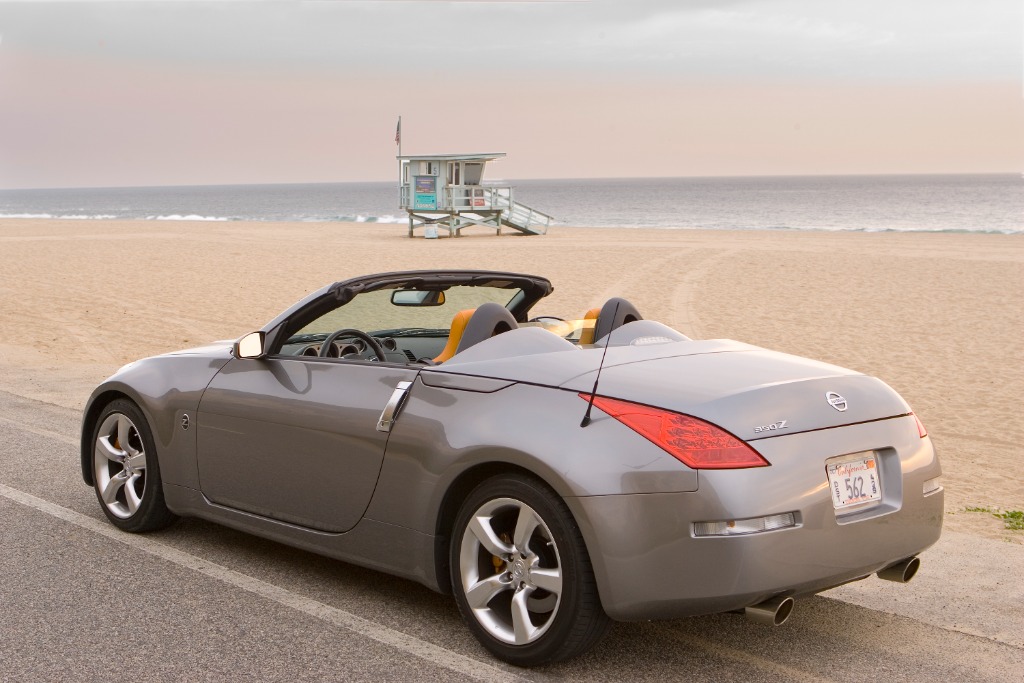
Roadster rear decklid: rigid tonneau cover with aerodynamic double streamliners and sleek taillights.
Source: © Nissan Motor Co.
2. Open-Air Comfort and Cabin Environment
The Roadster amplifies the mechanical wail of the VQ35 exhaust note. Top-spec versions equipped with the leather pack featured perforated burnt-orange heated leather sport seats (Alezan leather) and a clear glass wind deflector mounted between the fixed roll hoops to effectively minimize cabin buffeting at highway speeds.
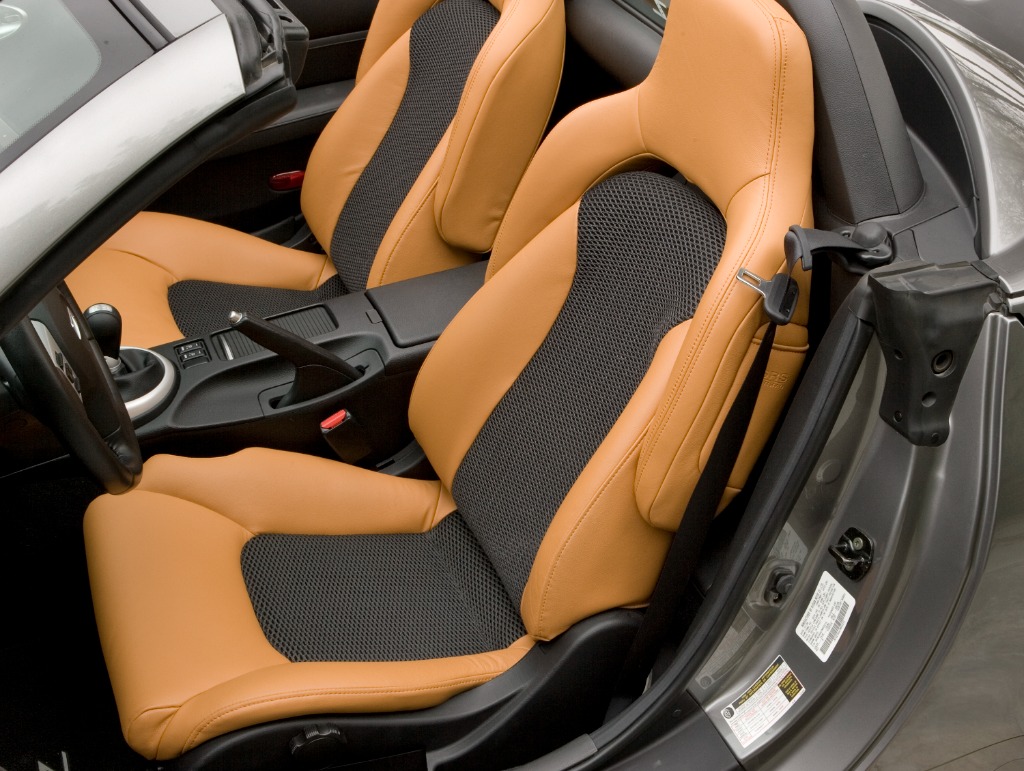
Sport seats in perforated burnt-orange Alezan leather: the signature interior upholstery of high-spec Roadster models.
Source: © Nissan Motor Co.
3. Soft Top Inspection Checklist
The convertible top mechanism is purely electro-mechanical, eliminating high-pressure hydraulic fluid leaks. Three wear items warrant inspection:
- Elastic Bungee Straps: Over time, these internal return straps stretch out. When worn, the roof bows fail to fold back cleanly, causing the canvas to snag against the tonneau lid. Replacing them takes about 30 minutes with reinforced aftermarket bungee kits that cost under $50.
- Fifth Bow and Tonneau Motors: When the mechanism hesitates or stalls, carbon brush dust inside the small electric drive motors can foul electrical contacts. Thorough cleaning often restores complete functionality without replacing the units.
- Passenger Window Regulator Motor: The folding sequence requires both side windows to index down slightly. If the passenger window motor hesitates, the computer aborts the roof cycle as a safety precaution.
[!NOTE] Used Market Valuation: The Roadster trades at a 20% to 30% discount relative to a comparable manual coupé (typically between €12,000 and €16,000 / $13,000 and $17,000 depending on condition). Historically shielded from track use or aggressive drift modifications, roadsters frequently present with lower mileage and documented servicing.
Technical Evolution & Model Years: From 280 to 313 Horsepower
Throughout its production run, the 350Z underwent three distinct mechanical evolutions:
1. Phase 1 (2002–2005): Original VQ35DE (280/287 hp)
The initial production version:
- Engine: 3.5-liter naturally aspirated VQ35DE V6 developing 280 metric hp (287 hp US spec) at 6,200 rpm and 274 lb-ft (363 Nm) of torque at 4,800 rpm. Redline at 6,600 rpm.
- Key Specs: Continuous Variable Valve Timing Control System (CVTCS) on intake only, single electronic throttle body, standard xenon headlights, incandescent taillights.
- Drivability: Abundant low-end and midrange torque. Virtually nonexistent oil consumption and remarkable long-term durability.
2. 2005 Model Year: “35th Anniversary” Special Edition (300 hp)
Built to celebrate 35 years of Z heritage (1969–2004), this edition debuted the uprated “Rev-up” VQ35DE.
- Engine Upgrades: Variable valve timing added to both intake and exhaust cams, revised camshaft profiles, and a reinforced bottom end.
- Output: 300 hp at 6,400 rpm, 260 lb-ft (353 Nm) at 4,800 rpm, with redline pushed to 7,000 rpm.
- Distinguishing Cues: Available in Ultra Yellow, Super Black, or Redline red (the livery of the car shown in this guide’s opening photo), unique 5-spoke 18-inch wheels, and Brembo brakes.
3. Phase 2 (2006–early 2007): Facelift & Standard Rev-up Engine (300 hp)
- Standardized Powertrain: The 300 hp Rev-up became standard equipment across all manual transmission coupés and roadsters.
- Styling Revisions: Restyled front bumper, bi-xenon headlights with integrated LED accents, full LED taillights, and redesigned 18-inch alloy wheels.
- Interior: Upgraded center console with round aluminum rotary climate controls and improved materials.
- Inspection Watchout: Certain production batches of Rev-up engines developed excessive oil consumption (at times exceeding 1 quart / 1,000 miles), stemming from factory piston ring sealing issues.
4. Phase 3 (2007–2009): The High-Revving VQ35HR (306/313 hp)
The final iteration represents the mechanical peak of the Z33 chassis. Nissan introduced the newly engineered VQ35HR (High Revolution / High Response), which shares roughly 80% new internal components compared to the DE:
- Engineering Overhaul: Cylinder block deck height increased by 8.4 mm to accommodate longer connecting rods (+7.6 mm), compression ratio raised to 10.6:1, and a symmetrical dual intake system (Twin Throttle) with two independent airboxes and dual electronic throttle bodies.
- Performance: 313 metric hp (306 hp SAE) at 6,800 rpm, 264 lb-ft (358 Nm) of torque at 4,800 rpm, and redline raised to 7,500 rpm (fuel cutoff at 7,600 rpm).
- Visual Distinction: A pronounced central hood power bulge, mandatory to clear the taller twin intake runners.
- Reliability: Abnormal oil consumption issues eliminated. However, the concentric hydraulic clutch slave cylinder (CSC) requires proactive monitoring.
| Specification | Phase 1 (2002–2005) | Phase 2 Rev-up (2005–2006) | Phase 3 HR (2007–2009) |
|---|---|---|---|
| Engine | VQ35DE | VQ35DE Rev-up | VQ35HR Twin Throttle |
| Power Output | 280 hp (287 hp US) @ 6,200 rpm | 300 hp @ 6,400 rpm | 313 hp (306 hp US) @ 6,800 rpm |
| Torque | 363 Nm (274 lb-ft) @ 4,800 rpm | 353 Nm (260 lb-ft) @ 4,800 rpm | 358 Nm (264 lb-ft) @ 4,800 rpm |
| Redline | 6,600 rpm | 7,000 rpm | 7,600 rpm |
| Intake System | Single throttle body | Single throttle body | Dual independent throttle bodies |
| Exterior Signature | Flat hood / Incandescent tails | Restyled fascia / Full LED tails | Hood with central power bulge |
| Oil Consumption | Low (< 0.3 L / 1,000 km) | Variable (can exceed 1 L / 1,000 km) | Negligible (< 0.2 L / 1,000 km) |
| Relative Market Value | Baseline reference | +10% to +15% | +40% to +60% (Most sought-after) |
Mechanical Architecture: The Naturally Aspirated VQ35 V6
The VQ35 is an all-aluminum 60-degree V6 (95.5 mm bore and short 81.4 mm stroke yielding 3,498 cc), renowned for mechanical toughness and repeatedly voted onto the Ward’s 10 Best Engines list.
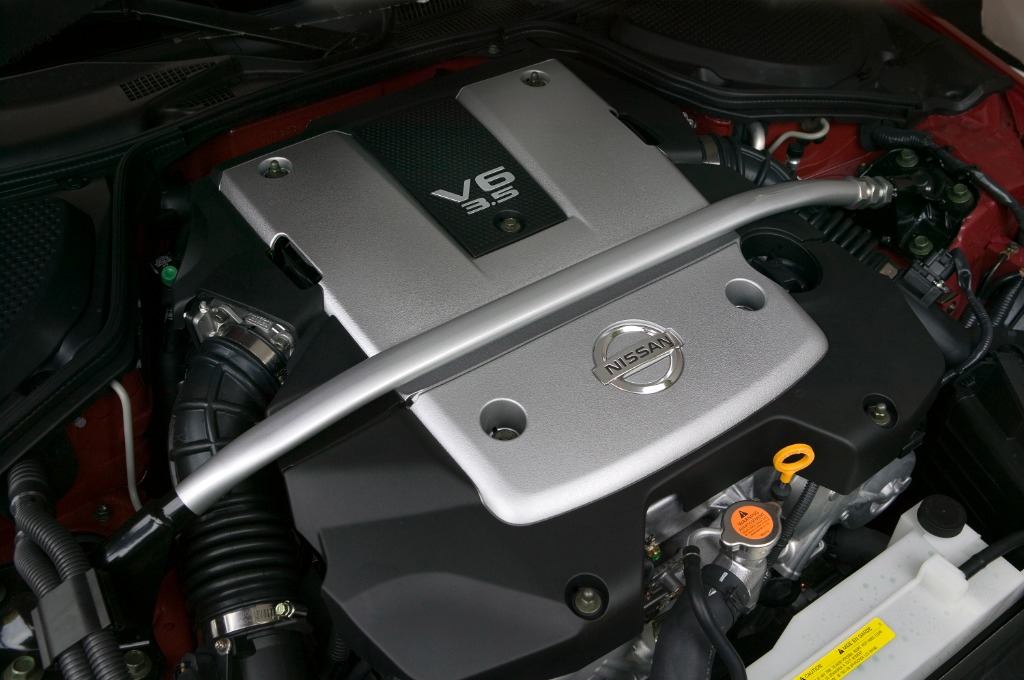
Engine bay: the 3.5L naturally aspirated V6 bridged by its structural aluminum strut tower brace connecting the front shock towers.
Source: © Nissan Motor Co.
Equipped with a robust timing chain system that requires no scheduled replacement and a voluminous intake plenum, this engine delivers muscular flexibility and instantaneous, linear throttle response across the rev band.
Chassis Dynamics and Driving Impressions
Out on the road, the Nissan 350Z relies on sound, classic mechanical engineering. Built on Nissan’s FM (Front Midship) platform, the engine is pushed well behind the front axle centerline, producing an optimal 53% front / 47% rear weight distribution.
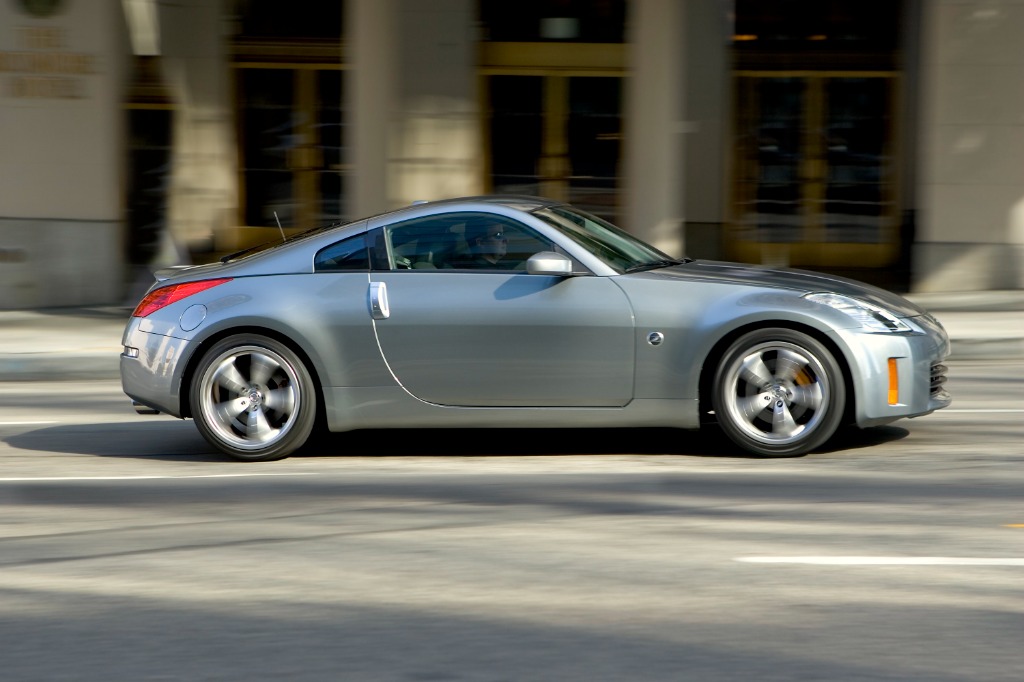
The 350Z under lateral load: low center of gravity, 104.3-inch wheelbase, and one-piece carbon fiber composite driveshaft.
Source: © Nissan Motor Co.
1. Tactile Feel and Feedback
- Mechanical 6-Speed Manual Shifter: The FS6R31A manual transmission features short throws and positive, rifle-bolt engagements. The shifter requires a deliberate, positive hand, fully in tune with the car’s purposeful character.
- Hydraulic Power Steering: Weighty at parking speeds, it provides clear, unfiltered communication from the aluminum multi-link front suspension once velocities rise.
- Carbon Fiber Composite Driveshaft: An exotic material in this price class, the single-piece carbon composite prop shaft reduces rotational inertia and sharpens throttle response upon tip-in.
- Viscous Limited-Slip Differential (VLSD): Standard equipment on European-market cars, it delivers strong traction out of apexes and predictable, progressive breakaway behavior at the limit.
2. An Authentic Analog Driving Experience
At its initial launch, period road tests occasionally faulted its 3,370 lb (1,530 kg) curb weight when compared to featherweight roadsters like the 2,800 lb Honda S2000. Two decades later, that curb weight places the 350Z comfortably on the lighter side of modern sports cars, many of which now exceed 3,600 to 3,900 lbs. With no active dampers, no artificial steering filters, and no synthetic engine noise piped through the speakers, the 350Z retains a raw, honest mechanical connection that contemporary performance machinery has largely lost.
Market Comparison: The 350Z vs Period Rivals
During the mid-2000s, the 350Z stood toe-to-toe against a formidable lineup of European sports cars:
| Model & Engine | Power & Weight | Architecture & Philosophy | Key Advantages vs 350Z | Drawbacks vs 350Z |
|---|---|---|---|---|
| Nissan 350Z (3.5L V6 Atmo) |
280 to 313 hp 1,530 kg (3,370 lbs) |
RWD GT coupe, front-midship layout, limited-slip differential | Price-to-performance ratio, standard Brembo brakes, bulletproof engine | Phase 1 cabin plastics, rear strut bar bisecting trunk |
| BMW Z4 3.0i / 3.0si (E85/E86) (3.0L Inline-6 M54/N52) |
231 to 265 hp 1,290 to 1,320 kg |
RWD roadster/coupe, naturally aspirated inline-six | Lighter by ~440 lbs (200 kg), more premium interior trim | Lower horsepower output, factory brakes fade sooner under heavy use |
| Audi TT 3.2 V6 Quattro (3.2L VR6) |
250 hp 1,520 kg (3,350 lbs) |
AWD coupe, Haldex all-wheel-drive system | Year-round all-weather traction, superior cabin build quality | Understeer at the limit, transverse engine layout |
| Porsche Boxster S (986/987) (3.2L / 3.4L Flat-6) |
260 to 310 hp 1,320 to 1,355 kg |
Mid-engine roadster, benchmark chassis balance | Exceptional agility, telepathic steering precision | Higher service costs, IMS bearing concerns (on 986/987.1) |
| Honda S2000 (2.0L 4-cyl VTEC F20C) |
240 hp 1,260 kg (2,780 lbs) |
Lightweight 2-seat roadster, 9,000-rpm high-revving engine | Benchmark manual shifter, lightweight nimbleness | Modest low-end torque (208 Nm / 153 lb-ft), snappy handling on wet roads |
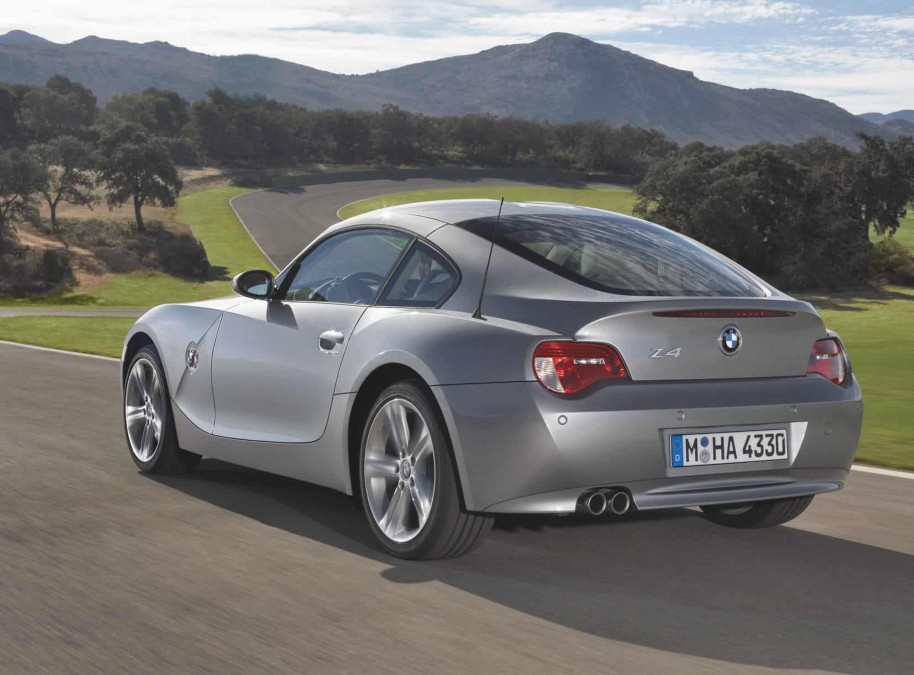
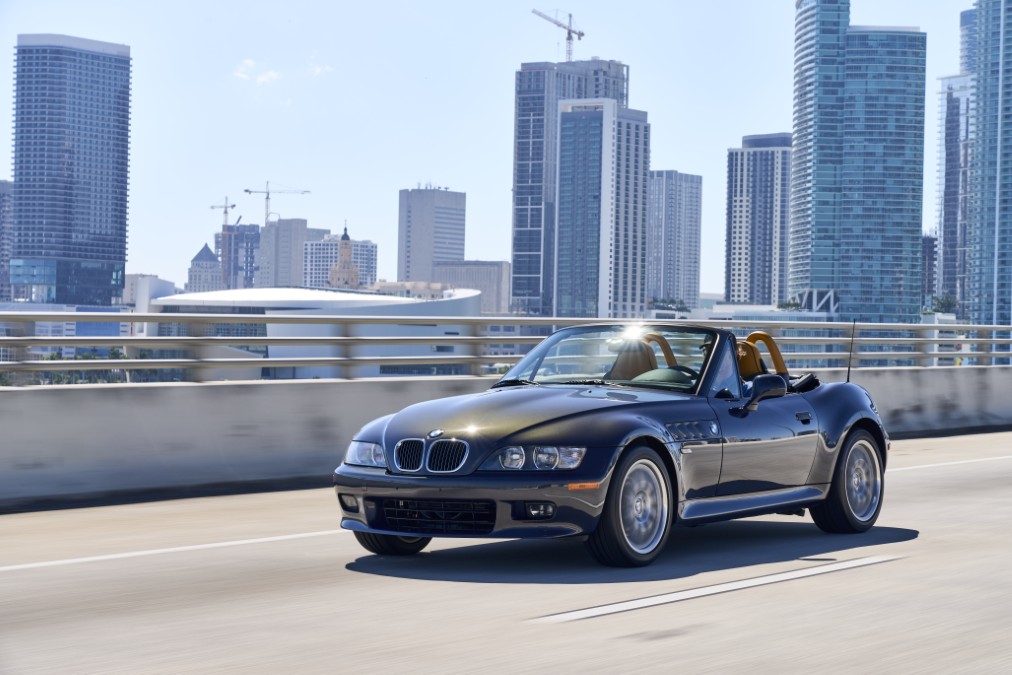
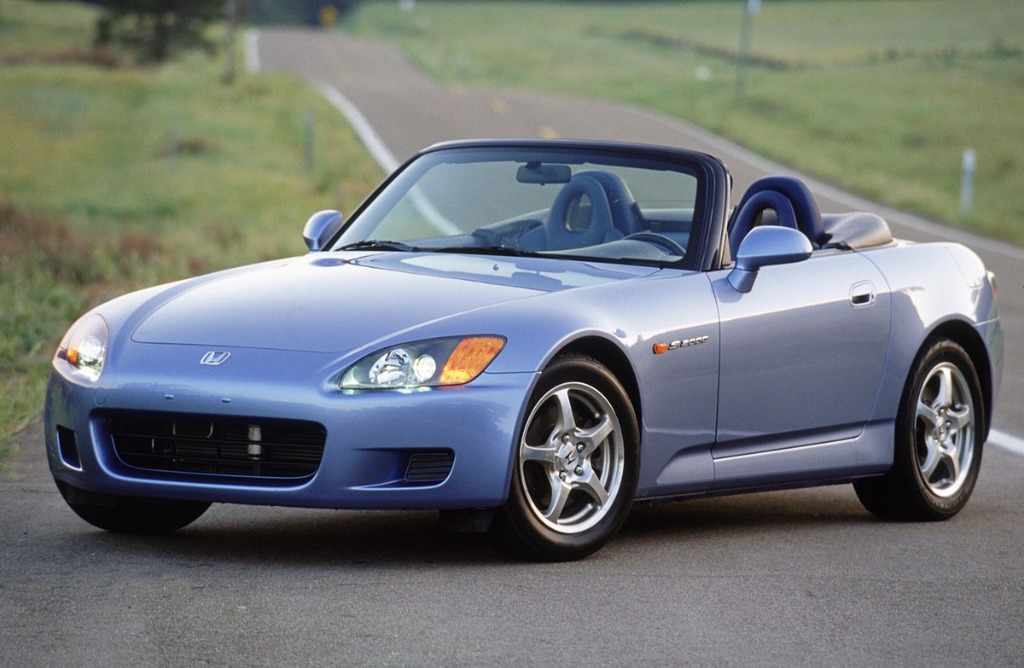
👉 Further reading: Explore our comprehensive investment guides on the BMW Z4 3.0si, the Porsche Boxster S (987.2), and the Honda S2000.
The Parallel with the BMW M3 (E36 & E46): A Striking Valuation Divergence
When expanding the analysis beyond pure two-seat roadsters, the Nissan 350Z draws direct technical and philosophical parallels with contemporary benchmarks of the naturally aspirated six-cylinder era: the BMW M3 E36 (3.2L 321 hp) and BMW M3 E46 (3.2L 333/343 hp).
On the road, the Japanese contender holds serious credentials against the Bavarian icons:
- Road Presence and Stance: With very wide tracks (1,535 mm front, 1,545 mm rear), flared muscular hips, and a low-slung seating position, the 350Z exerts a road presence every bit as dramatic as an M3, which shares its core silhouette with a mass-produced daily sedan.
- Architecture and Powertrain Appeal: Large-displacement naturally aspirated six-cylinder engine (3.5 liters for Nissan versus 3.2 liters for BMW), mechanical 6-speed manual transmission, rear-wheel drive equipped with a limited-slip differential, and fixed Brembo calipers standard. The low-end torque delivery of the VQ35 directly rivals the linear surge of BMW’s S50/S54 engines.
Yet, historical values on the modern classic market have followed dramatically diverging curves:
- A clean BMW M3 E36 with a manual gearbox commands between €25,000 and €35,000, while a well-documented manual M3 E46 coupé frequently climbs past €40,000 to €50,000+.*
- In contrast, a strictly stock 280 hp Nissan 350Z trades between €16,000 and €20,000 (and around €25,000 for a pristine 313 hp HR). The price delta reaches 50% to 60% in favor of the German sports cars.
Several core dynamics explain this market gap:
- Motorsport Heritage and Prestige: The historical aura of the BMW M badge and extensive touring car racing victories earned the M3 an immediate collector pedigree. Nissan, despite the legacy of the Datsun 240Z and the Skyline GT-R, was perceived more as a mainstream automaker in Europe during the 2000s.
- Everyday Practicality: M3s remain true four-seater coupés with a generous trunk, capable of double duty as long-distance grand tourers or family weekenders. The 350Z is a strict two-seater whose cargo space is bisected by its structural strut bar.
- Depreciation Curve Lag: The E36 M3 also endured a prolonged period of neglect and drift/track abuse between 2005 and 2015, before the market woke up to the scarcity of unmolested cars. The 350Z is following this exact trajectory, on an approximate ten-year lag.
[!TIP] The Ownership Cost Advantage in Favor of the 350Z: For enthusiasts craving a characterful naturally aspirated performance car, the 350Z offers far more predictable running costs. Unlike the S54 engine in the E46 M3, which demands expensive preventive overhauls (rod bearing replacement, double VANOS rebuilds, rear subframe floor crack reinforcement), the Nissan VQ35 V6 suffers from no bottom-end weaknesses and relies on a maintenance-free timing chain. Delivering comparable sensory thrills and muscular stance, the ownership cost-to-pleasure equation tilts decisively toward the Japanese coupe.
350Z HR (313 hp) vs 370Z (328 hp): Two Distinct Philosophies
The comparison between the final 350Z HR (313 hp) evolution and its successor, the 370Z (328 hp), is frequently debated among prospective buyers:
| Criterion | Nissan 350Z HR (2007–2009) | Nissan 370Z (2009–2020) |
|---|---|---|
| Engine | 3.5L V6 Atmo (VQ35HR) | 3.7L V6 Atmo (VQ37VHR) |
| Power & Peak Revs | 313 hp @ 6,800 rpm (7,500 rpm redline) | 328 hp @ 7,000 rpm (7,500 rpm redline) |
| Wheelbase & Weight | 2,650 mm (104.3 in) / ~1,530 kg (3,370 lbs) | 2,550 mm (-100 mm / -3.9 in) / ~1,495 kg (-35 kg) |
| Chassis Dynamics | Progressive, predictable at the limit | Shorter wheelbase, sharper turn-in, twitchier at the limit |
| Transmission Dynamics | 100% manual rev-matching (heel-and-toe) | SynchroRev Match system (automatic throttle blips) |
| Factory Exhaust Note | Deep, throaty mechanical growl | Higher-pitched tone, oil cooler recommended for track work |
| Production Volume | Very low in Europe (< 300 units in France) | Broad production volume over an 11-year run |
| Market Status / Investment | Coveted Modern Classic collector, firming values | Modern used sports car, stable market value |
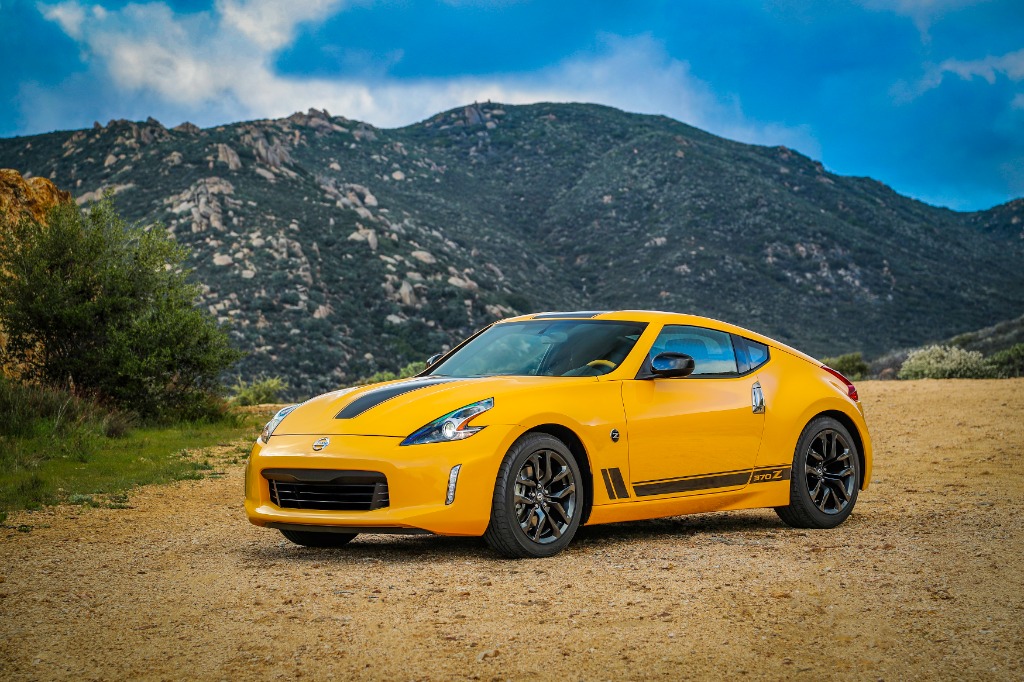
The Nissan 370Z: 100 mm shorter wheelbase, boomerang lighting, and a 328 hp 3.7L V6 featuring the SynchroRev Match rev-matching system.
Source: © Nissan Motor Co.
Comparative Takeaways:
- Daily Usability and Modern Amenities: The 370Z offers a more refined interior, slightly more compact external dimensions, and a more accessible trunk thanks to the removal of the center crossbar.
- Investment Potential and Collector Appeal: The 350Z HR presents superior collector fundamentals. Its rarity on the European market, completely analog manual gearbox, and foundational design make it the most coveted variant among Z-car purists.
Reliability and Pre-Purchase Checklist
While the VQ35 platform is celebrated for high-mileage resilience (with many examples easily passing 125,000 miles / 200,000 km on original internals), several inspection points require systematic scrutiny before purchasing:
1. Engine Oil Consumption (Specific to the 300 hp Rev-up)
The 300 hp Rev-up engines produced in 2005 and 2006 can suffer from excessive oil consumption caused by oil control ring sealing issues. In severe cases, consumption can reach 1 quart per 1,000 miles (1 liter per 1,000 km). Regular dipstick checks are vital to prevent engine starvation. On standard 280 hp DE and 313 hp HR models, this issue is virtually nonexistent (normal consumption is under 0.3 qt / 1,000 miles).
2. Concentric Slave Cylinder (CSC Failure - Specific to the 313 hp HR)
On the HR version, the traditional external clutch fork was replaced with an internal Concentric Slave Cylinder (CSC) mounted inside the bellhousing. Under elevated thermal loads, the factory composite cylinder can fail, leaving the clutch pedal pinned to the floorboard. Installing an upgraded aftermarket all-metal CSC kit during a clutch replacement permanently resolves this issue.
3. Gearbox Synchronizers (Early 2003 Models)
The very earliest 2003 models (transmission case codes CD001 through CD005) suffered premature synchronizer ring wear on 3rd and 5th gears, manifesting as grinding during fast shifts. From late 2004 onward, Nissan remedied this with the updated CD009 revision featuring triple-cone synchros, which has become the gold standard for durability.
4. Electric Window Regulator Motors
A frequent quirk of the Z33: carbon brush dust accumulating inside the window regulator motor can stall the glass or prevent the automatic short-drop indexing needed when opening and closing the frameless doors. Replacing or cleaning the motor is simple and inexpensive.
5. Rear Differential Subframe Bushing
The top differential mount bushing pressed into the rear subframe is fluid-filled. Over time, the rubber membrane can rupture, leaking silicone fluid down the differential cover and causing thumps during gear changes. Upgrading to a polyurethane bushing is the standard and permanent cure.
6. Camshaft and Crankshaft Position Sensors
Subjected to extreme underhood heat cycles, these Hall-effect sensors can fail intermittently over time, leading to sudden stalling, extended cranking, or a Check Engine Light (codes P0340/P0345). Replacing them with genuine OEM Nissan or original equipment Hitachi sensors is strictly recommended for trouble-free operation.
7. Undercarriage Corrosion (Imported Vehicles)
While the galvanized chassis offers decent factory corrosion protection, many examples for sale in Europe originated in Germany, Switzerland, or the UK, where winter road salt is prevalent. A thorough inspection on a lift is mandatory to check for structural rust on the rear subframe mounting points, wheel arches, and rear shock towers.
Factory Originality: The Decisive Value Multiplier
A clear analysis of the Nissan 350Z market reveals one undeniable conclusion: the true scarcity of the 350Z lies in the preservation of its factory originality.
1. The Legacy of the Aftermarket Tuning Craze
Between 2008 and 2018, rock-bottom used prices (often dipping below $10,000 / €10,000) subjected the 350Z to an overwhelming wave of aggressive modifications:
- Loss of Factory Components: Countless cars had their tuned factory airboxes swapped for hot-air open cone filters, their exhausts butchered without proper backpressure, or their lightweight forged RAYS wheels replaced with cheap heavy cast replicas.
- Chassis Stress: Cars subjected to repeated drift events or slammed on rock-hard coilovers frequently exhibit premature fatigue in the rear suspension mountings and subframe bushings.
- It is estimated that an overwhelming majority of surviving Z33s have undergone cosmetic or mechanical alterations.
2. Market Bifurcation: The Premium for Bone-Stock Cars
This backdrop has produced a stark divergence on classified platforms:
- Modified Cars or Incomplete Histories: These face sluggish demand and flatlined valuations between €12,000 and €15,000, being largely dismissed by serious collectors.
- Strictly Original Examples: A factory-stock manual European coupé retaining its original panels, factory paint, intact interior, OEM wheels, and complete service records commands an immediate 30% to 50% price premium and sells rapidly.
[!IMPORTANT] The Economics of Reversing Modifications: Attempting to return a heavily modified 350Z back to OEM spec is rarely a profitable calculation: the combined expense of sourcing genuine parts (OEM airbox assembly, unmolested exhaust, factory wheels, intact interior panels) and labor regularly exceeds any initial purchase savings. Paying more upfront for a completely bone-stock, clean example is the safest and most profitable investment strategy.
Market Outlook: Which Model Should You Buy?
Having bounced off its market bottom in the mid-2010s, the Nissan 350Z is firmly cementing its position among top Japanese modern classics. Buyers generally target one of three profiles:
1. The Sensible Benchmark: The Stock 280 hp Manual Coupé (€16,000 – €20,000 / $16,000 – $22,000)
The most accessible and reliable entry point. Its original VQ35DE does not suffer from chronic oil consumption, replacement parts are abundant, and pristine examples are seeing steady appreciation. Priority should go to cars with the factory leather pack and lightweight forged RAYS wheels.
2. The Open-Air Value Proposition: The Roadster (€12,000 – €16,000 / $13,000 – $17,000)
For weekend touring and leisurely drives, the convertible offers unbeatable value. Priced 20% to 30% below a comparable coupé, generally displaying lower mileage and spared from drift modifications, it delivers unmatched open-air bang-for-your-buck.
3. The Collector’s Holy Grail: The 313 hp HR Coupé (€24,000 – €30,000 / $25,000 – $35,000)
Built for only two model years (2007–2009) and with fewer than 300 units delivered in France, the HR coupé with its distinctive hood bulge is the collector favorite. Its 7,500-rpm redline, robust dual-throttle engine, and scarce European numbers grant it the highest long-term investment upside.
| Model & Version | Powertrain | Estimated Production | Indicative Market Value (Europe / US) | Investment Profile |
|---|---|---|---|---|
| 350Z Coupé Phase 1 (2003–2005) | VQ35DE 280/287 hp | ~160,000 units | €16,000 – €20,000 / $16k – $22k | Balanced entry point, reliable bulletproof V6 |
| 350Z Roadster (2005–2009) | 280, 300, or 313 hp | ~45,000 units | €12,000 – €16,000 / $13k – $17k | Accessible open-top cruiser, attractive depreciation |
| 35th Anniversary Edition (2005) | VQ35DE Rev-up 300 hp | Numbered limited run | €20,000 – €25,000 / $22k – $28k | Commemorative edition, exclusive colors (Ultra Yellow, Redline), Brembos |
| 350Z Coupé Phase 2 (2006) | VQ35DE Rev-up 300 hp | ~30,000 units | €17,000 – €21,000 / $17k – $23k | Updated interior styling; inspect oil consumption |
| 350Z Coupé Phase 3 HR (2007–2009) | VQ35HR 306/313 hp | < 15,000 units | €24,000 – €30,000 / $25k – $35k | Definitive version, 7,500 rpm redline, scarce European allocation |
| NISMO 350Z / 380RS (Japan / US) | 306 hp / 350 hp | 300 units (380RS) | €35,000 – €75,000+ / $40k – $100k+ | Dedicated JDM and US market limited collector editions |
Conclusion: An Analog Modern Classic
In an automotive landscape increasingly dominated by small-displacement turbochargers, paddle-shift automatic transmissions, and intrusive driver-assistance electronics, the Nissan 350Z stands out as a wonderfully direct and mechanical sports car.
With its large-displacement 3.5-liter naturally aspirated V6, notchy short-throw manual gearbox, playful yet communicative rear-wheel-drive dynamics, and clean fastback proportions, it remains one of the most compelling Japanese sports cars of the 2000s. Still obtainable under €20,000 / $20,000 for a well-maintained, strictly original example, it represents a secure, high-reward investment in the modern classic landscape.
Car Evaluation
Evaluation Criteria
Appreciation Potential
Potential for value increase over time
"After a prolonged period of depreciation, values for unmodified Nissan 350Zs have stabilized and are trending upward. Finding a bone-stock, clean example is now the main challenge for buyers, as a large portion of existing cars were modified, drifted, or abused on track. Pristine original examples with documented service history command a significant market premium."
Ownership Cost
Total cost of ownership including maintenance, insurance, and running costs
"The naturally aspirated VQ35DE V6 is renowned for its mechanical durability when routine maintenance and oil levels are strictly monitored. Free from forced induction or complex electronics, maintenance costs remain very reasonable for a sports coupe in this performance bracket. Consumables and replacement parts are widely available and affordable."
Driving Pleasure
Pure driving enjoyment and emotional connection
"A visceral, direct, and communicative sports car. The 3.5-liter V6 delivers linear, meaty torque right from the bottom end, paired with a solid, mechanical 6-speed manual gearbox, a balanced 53/47 weight distribution, and a standard limited-slip differential in European specification."
Market Liquidity
Ease of selling when needed
"Demand is strong and steady for strictly original, manual-gearbox coupés. Conversely, heavily modified examples or cars with spotty service history suffer steep discounts and take considerably longer to sell."
Exclusivity & Rarity
How rare and exclusive the vehicle is
"With approximately 250,000 units produced worldwide, the 350Z is not rare in raw numbers. Rarity lies strictly in its state of preservation: completely unmolested European-spec cars with full service records are genuinely hard to come by today, with only about 2,500 units sold new in France."
Similar Cars
Related Articles