Porsche 911 (996) Turbo: From Le Mans GT1 to the Road

Specifications
Basic Information
Performance & Value
The Ultimate Weapon of the 996 Generation
Unveiled at the Frankfurt Motor Show in 1999 and hitting the market for model year 2001 (2000 in Europe), the Porsche 911 (996) Turbo marked a pivotal milestone for the Stuttgart brand. It was the first production Turbo to abandon air-cooling in favor of water-cooling—a transition that initially ignited fury among purists.
Yet beneath this liquid-cooled revolution lies one of the noblest and most indestructible engines in motorsport history: the Mezger block. In 2026, as 993 Turbo and 997 Turbo values soar into the stratosphere, the 996 Turbo stands out as a glaring market anomaly and one of the smartest supercars to invest in.
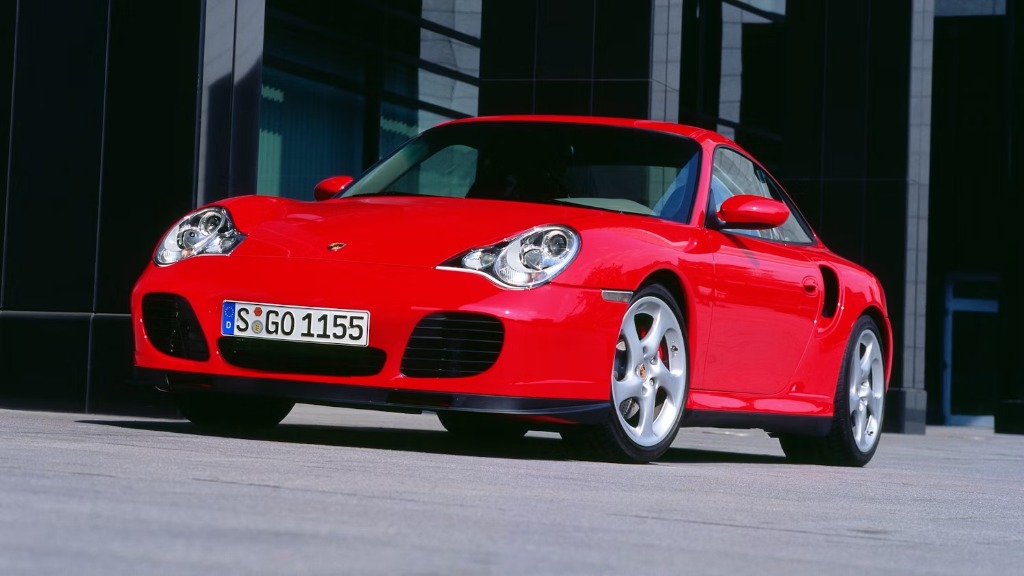
The Porsche 911 (996) Turbo: a wide, timeless silhouette that grows finer with age.
Source : © Porsche AG
Design : The Quiet Confidence of Widebody Proportion
Visually, the 996 Turbo immediately sets itself apart from the standard Carrera with a far more aggressive stance. Its rear track, widened by 2.36 in (60 mm), gives it a hunkered-down, muscular presence on the road.
Its model-specific front fascia features three massive rectangular air intakes designed to feed the front water radiators, while the rear fenders incorporate generous side air scoops engineered to ram cool air into the twin-turbo system’s intercoolers. Out back, the biplane active rear spoiler and bumper-integrated exhaust tips assert its supercar credentials. Its smooth headlight lenses (shared with the Carrera 4S) bypass the controversial “fried egg” look of the Phase 1 Carrera, granting it a sleek, modern, and perfectly balanced profile.
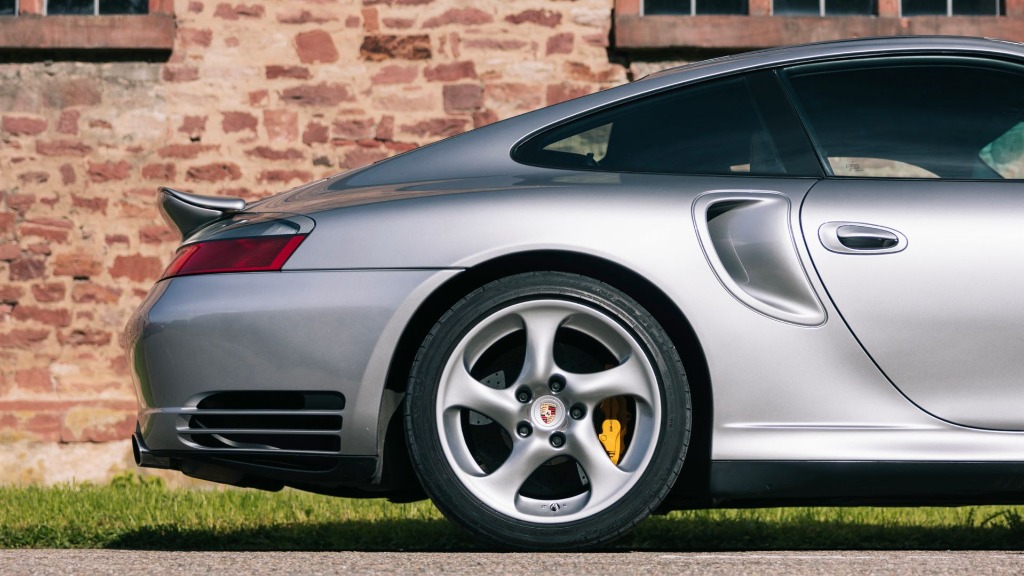
Widened rear fenders (+2.36 in / +60 mm) and generous side scoops feed cool air directly to the Mezger block’s intercoolers.
Source : © Porsche AG
Habitacle : A High-End Cabin Reconsidered
The cabin of the 996 generation long faced criticism for its sea of grey plastics and austere center console. However, as the flagship model, the Turbo enjoyed premier treatment: a full leather interior as standard equipment.
The dashboard, door panels, center console, and instrument cluster surround are entirely wrapped in hand-stitched leather. Paired with a standard genuine Alcantara headliner and the iconic five-gauge instrument cluster, the 996 Turbo’s interior delivers a warm, luxurious, and refined environment. This abundance of noble materials provides an upscale ambiance that completely erases memories of the entry-level Carrera’s cost-cutting.
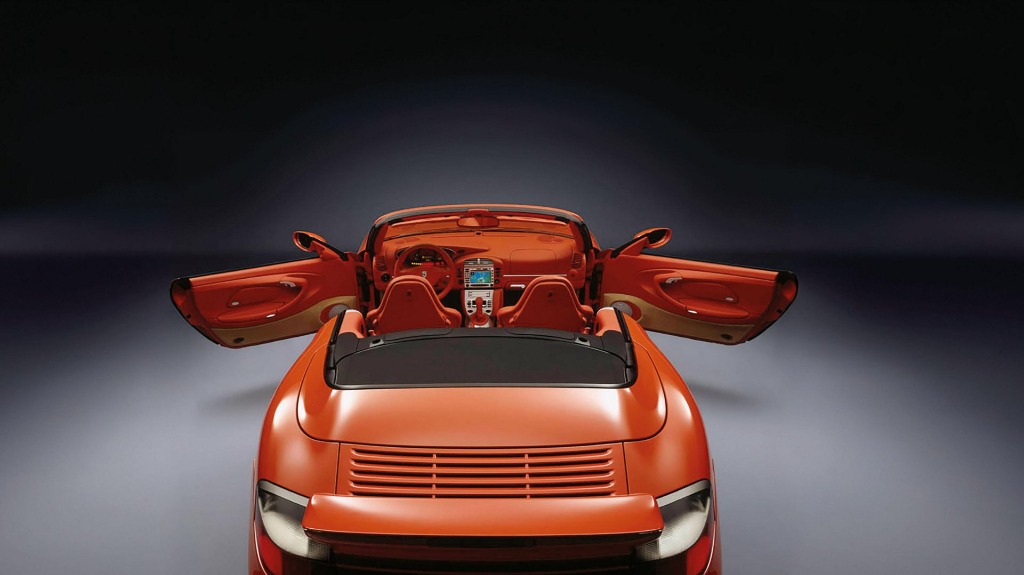
The standard full extended leather interior (dash, door panels, and center console) imparts an unmistakable sense of prestige and quality.
Source : © Porsche AG
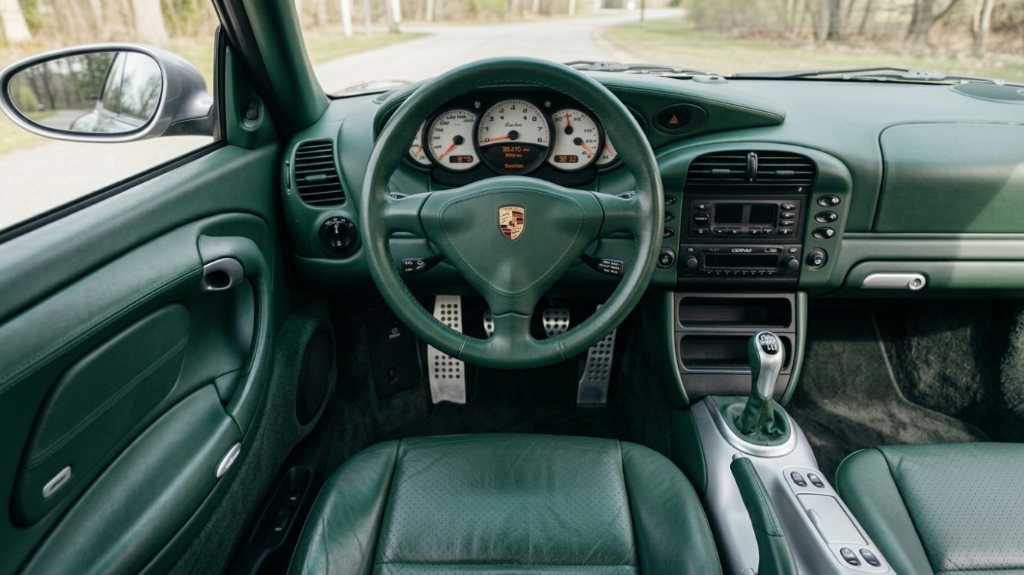
The cockpit of a Porsche 911 (996) Turbo finished in iconic Nephrite Green leather—a rare and highly coveted Porsche Exclusive specification.
Source : © mydriveROI.com
Évolutions et Millésimes : No Exterior Facelift, But Crucial Running Changes
Unlike the base Carrera, which received a visible mid-cycle facelift for 2002 (Phase 2 adopting Turbo-style headlights and a 3.6L engine), the 996 Turbo never underwent an exterior facelift. Its exterior design remained strictly identical from its 2000 launch through the end of production in 2005.
However, it received critical technical and equipment upgrades across model years that every buyer must understand:
Model Year 2002 (MY02)
- Introduction of the Glovebox : The most requested daily-usability upgrade. MY2001 models lacked a glovebox altogether (a major complaint when new). The interior also gained cupholders and updated soft-touch interior coatings.
- Introduction of the X50 Option (factory power kit bumping output to 444 hp / 450 PS).
- Optional X73 & X74 M030 Sport Suspensions : Stiffer, lower factory suspension setups for aggressive driving.
Model Year 2003 (MY03)
- PCM 2.0 Infotainment : The factory navigation/audio head unit transitioned to a modern 16:9 widescreen format with higher resolution.
- MOST Fiber-Optic Architecture : The Bose sound system switched to fiber-optic wiring, enhancing audio quality but adding complexity for aftermarket stereo installations.
Model Year 2004 (MY04)
- Introduction of the Cabriolet : The return of a factory Turbo Convertible for the first time since the G-series 930 Turbo in 1989.
Model Year 2005 (MY05)
- The Turbo S Model : The ultimate evolution of the 996. It bundled the X50 444-hp package and PCCB carbon-ceramic brakes (yellow calipers) as standard, making it the most coveted variant among collectors.
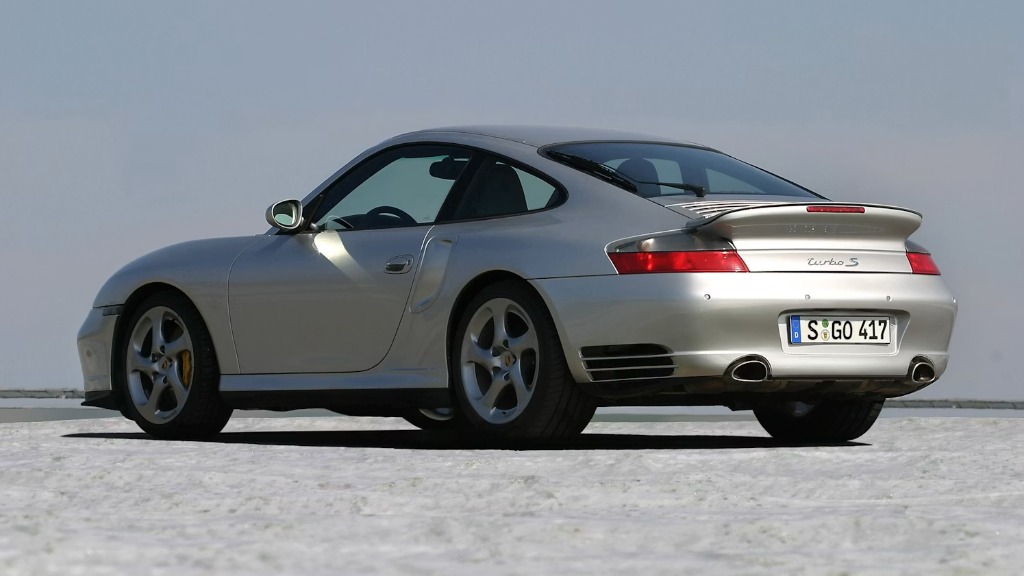
The Porsche 911 (996) Turbo S (MY05): distinguished by yellow PCCB ceramic brake calipers and its model-specific rear badge.
Source : © Porsche AG
Mécanique : The Mezger Engine, A Motorsport Masterpiece
At the heart of the 996 Turbo is its 3.6-liter twin-turbocharged flat-six, universally known as the Mezger engine (named after legendary engineer Hans Mezger). Unlike the M96 engine found in contemporary Carreras—which suffers from well-documented design flaws like IMS bearing failures, cylinder bore scoring, and wet-sump oil starvation—the Mezger block traces its lineage directly to the Le Mans-winning 911 GT1 race car.
This powerplant utilizes a true dry-sump lubrication system with an external oil reservoir and an ultra-robust split-crankcase design free of any IMS vulnerability. Producing 415 hp (420 PS) and 413 lb-ft of torque from just 2,700 rpm, this engine boasts legendary durability and can comfortably withstand substantial power modifications on stock internals. Power is routed through either a sublime Getrag 6-speed manual transmission (highly desirable) or a robust but less engaging Mercedes-sourced 5-speed Tiptronic automatic.
Unlike subsequent 911 Turbo generations (997 onwards) that adopted Variable Turbine Geometry (VTG) turbos to smooth out power delivery, the 996 Turbo retains conventional fixed-geometry KKK turbos. This mechanical setup gives it a visceral, old-school turbo lag. Below 3,000 rpm, the engine is docile; then boost hits suddenly in the K16 (or K24) turbines, delivering a violent, addictive surge of acceleration. It is this raw, physical, and authentic character—typical of 1990s/2000s supercars—that captivates purists seeking genuine mechanical engagement over modern linear speed.
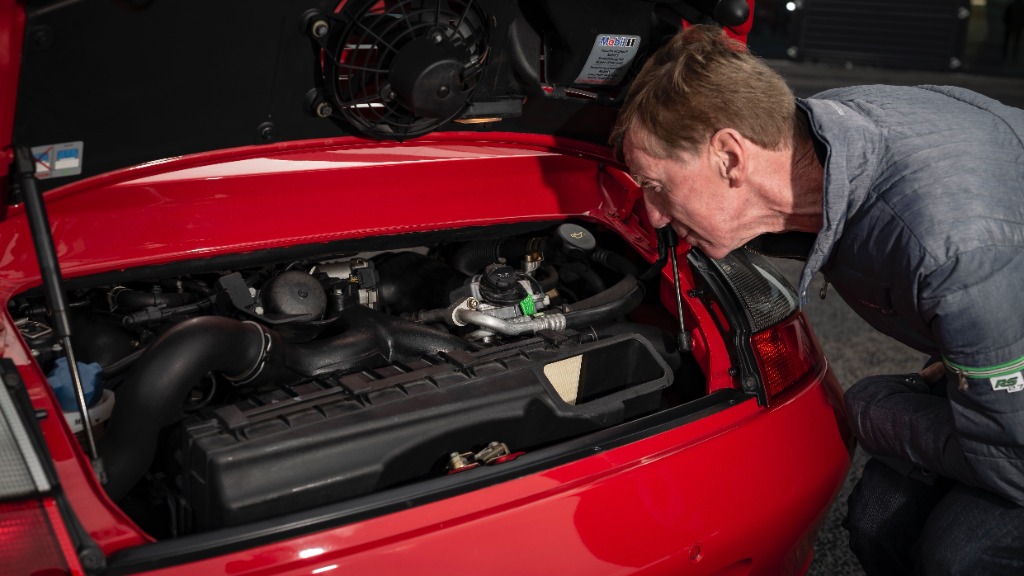
Legendary test driver Walter Röhrl inspecting the engine bay of the 996 Turbo and its 3.6L Mezger powerplant.
Source : © Porsche AG
The X50 Powerkit and Turbo S : Ultimate Specification
Beginning in 2002, Porsche offered a rare factory option priced at nearly $18,000: the X50 Powerkit. This increased output to 444 hp (450 PS) and 457 lb-ft of torque (available from 3,500 to 4,500 rpm). Far beyond a simple ECU flash, the X50 package incorporated major hardware upgrades borrowed directly from the hardcore 996 GT2:
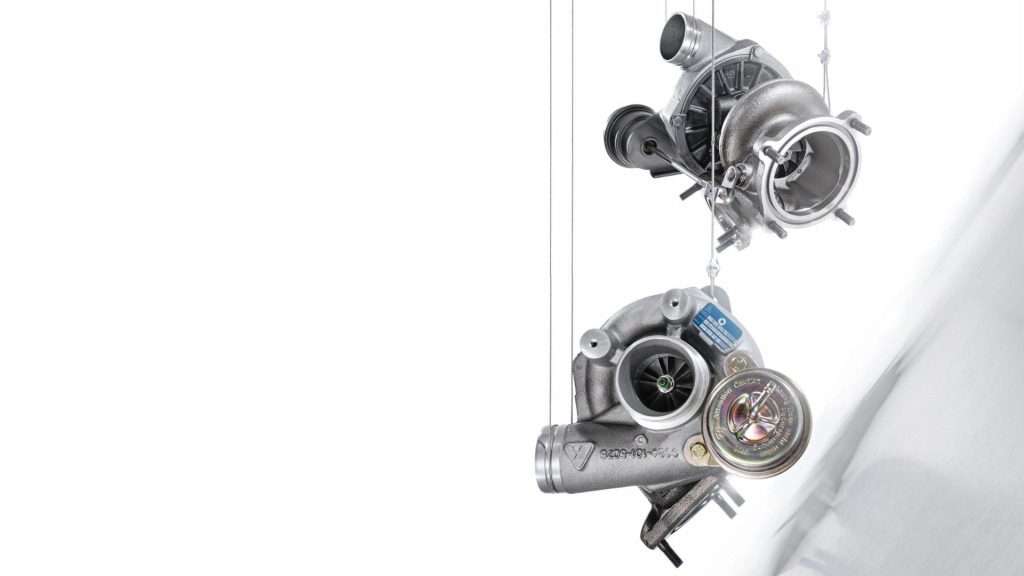
KKK K24 turbochargers from the factory X50 package (boosting output to 444 hp), identified by their manufacturer data plates.
Source : © Porsche AG
- Larger KKK K24 Turbochargers (replacing the standard K16 units).
- Larger GT2-spec Intercoolers.
- Reinforced 6-Speed Manual Transmission (strengthened Getrag G96/50 gearbox casing to handle extra torque).
- Sport Exhaust System featuring distinctive stacked dual oval exhaust tips.
With these upgrades, 0–60 mph dropped to 3.7 seconds (0–100 km/h in 4.0 s) with a top speed of 191 mph (307 km/h). In 2005, to celebrate the end of the 996 run, Porsche standard-fitted the X50 package on a rare, capstone model: the 996 Turbo S, which also came standard with PCCB carbon-ceramic brakes.
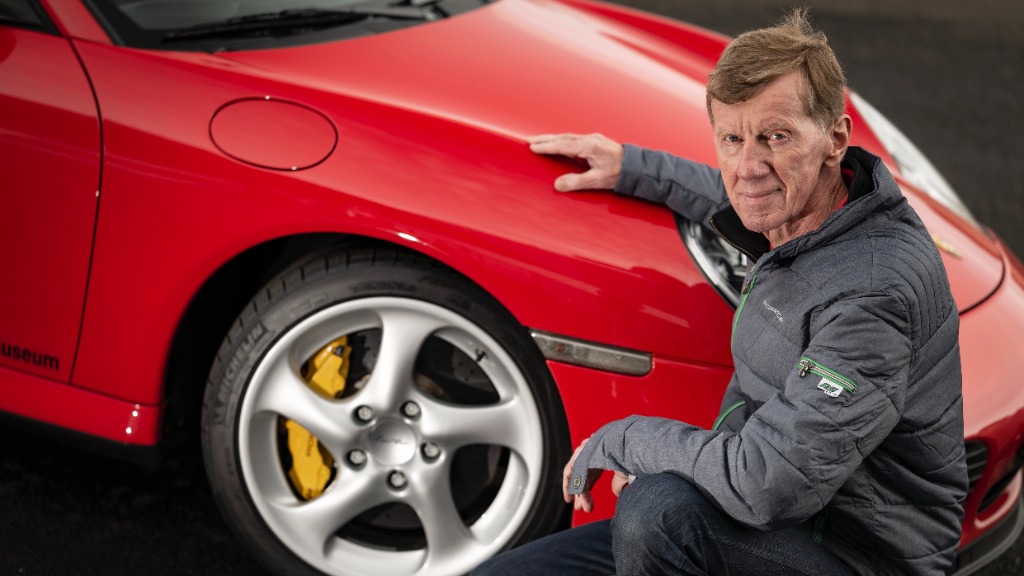
Walter Röhrl alongside the front wheel of a 996 Turbo S showcasing the yellow calipers of the standard PCCB carbon-ceramic braking system.
Source : © Porsche AG
Production Figures & Rarity :
Because the X50 was an optional equipment code, Porsche never published official global breakdown numbers. Registry estimates suggest approximately 2,000 to 2,500 total units (Coupes and Cabriolets combined) left the factory with X50 worldwide (including 1,124 confirmed for the North American market).
The 996 Turbo S is even rarer and meticulously cataloged. A total of just 1,563 units were produced globally:
- 600 Coupes
- 963 Cabriolets
These low production numbers make X50 and Turbo S models prime collector targets, commanding a 15% to 25% price premium over standard 415-hp models.
Sur la route : Uncompromising Real-World Performance
On the road, the 996 Turbo delivers a blend of all-weather capability and explosive performance that remains astonishing today. Its viscous-coupling all-wheel-drive system (a purely mechanical setup) routes between 5% and 40% of torque to the front wheels whenever rear slip occurs, ensuring incredible traction under any road condition.
Dynamically, the 996 Turbo strikes a masterclass balance:
- Stabilité et sécurité : Its wheelbase was extended to 92.6 in (2,352 mm)—an increase of 3.1 in (80 mm) over the 993 Turbo—providing rock-solid high-speed stability through sweeping bends while making breakaway at the limit far more progressive and forgiving.
- Controlled Weight : Weighing in at just 3,395 lbs (1,540 kg)—a mere 88 lbs more than the air-cooled 993 Turbo—it represents a phenomenal engineering feat given the addition of liquid cooling, radiators, and enlarged dimensions.
- Analog Driving Purity : It retains a razor-sharp, hydraulic steering rack, tactile mechanical controls, and an intimate connection to the road. While the subsequent 997 generation thankfully preserved this hydraulic steering feel, the 996 Turbo stands today as the ultimate value play against its air-cooled 993 ancestor, delivering vastly superior performance and pure driving feedback at a third of the entry price.
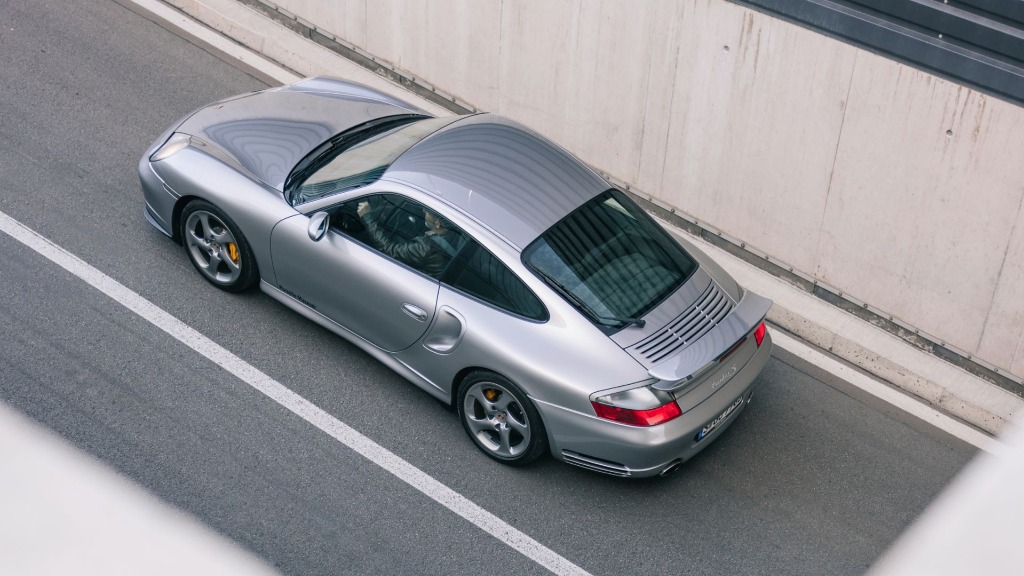
The 996 Turbo stretching its legs: effortless high-speed stability courtesy of its 92.6-in wheelbase and all-wheel-drive traction.
Source : © Porsche AG
Vs Period Supercars : Insolent Real-World Dominance
In the early 2000s, the 996 Turbo rewrote the supercar rulebook. Against rival exotics of its era, it delivered crushing real-world performance:
- The Stopwatch Verdict : Sprinting 0–60 mph in 3.9 seconds (3.7 s for X50), it blew past direct competitors like the Ferrari 360 Modena (4.3 s), BMW Z8 (4.5 s), and Aston Martin DB7 Vantage V12 (4.9 s). Its 189+ mph (305 km/h) top speed shattered the mythical 300 km/h threshold, an elite club at the turn of the millennium.
- All-Weather Weapon vs. Exotic Divas : Where a mid-engine rear-wheel-drive Ferrari 360 demanded dry pavement and race-driver concentration to exploit, the 996 Turbo deployed absolute traction via its viscous AWD. On wet, cold, or bumpy backroads, the Porsche effortlessly pulled away, allowing instant, stress-free utilization of its 413 lb-ft of torque.
- The Ultimate Daily Supercar : Continuing the legacy of the 930 and 993 Turbos, the 996 elevated usability to unprecedented heights. Capable of matching hypercars like the Lamborghini Diablo VT 6.0 or Ferrari 550 Maranello in flat-out acceleration (at half the price tag), it offered the ergonomics, climate control, and mechanical dependability of a daily driver. This juxtaposition of supercar speed and daily usability earned it legendary status as the ultimate “giant killer”.
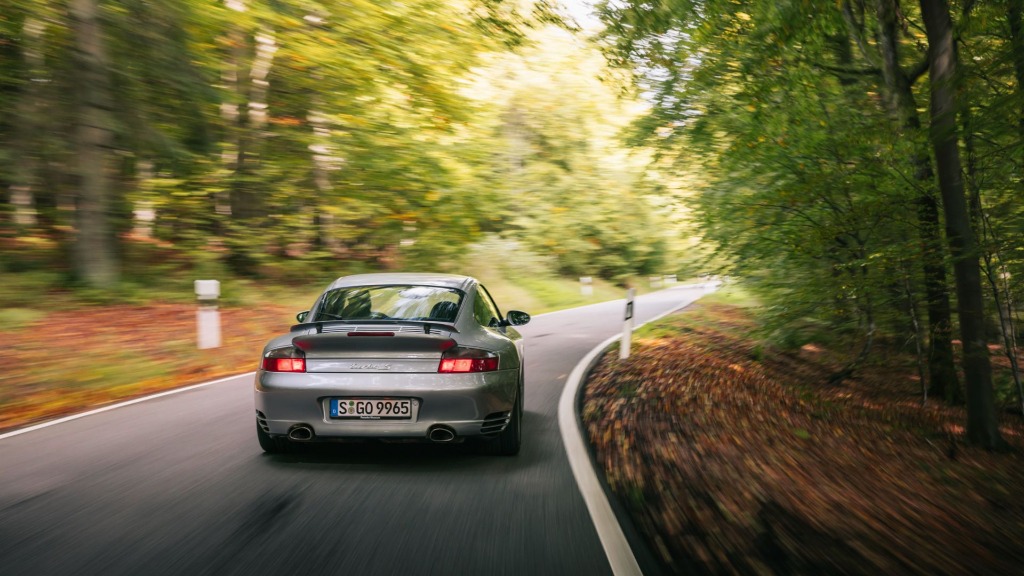
The 996 Turbo in action: the perfect combination of a world-class chassis, AWD traction, and daily usability.
Source : © Porsche AG
Fiabilité : Buyer’s Guide & Known Weak Spots
While the Mezger engine is exceptionally durable, every 996 Turbo is now over 20 years old and warrants a meticulous inspection of known age-related issues:
1. Glued Coolant Pipe Failures
The single most infamous issue on Mezger blocks. Porsche used epoxy glue to secure aluminum coolant pipe fittings into the engine housing. Over time and thermal cycles, the epoxy degrades, causing fittings to suddenly slip out. This dumps coolant directly onto the rear tires, risking immediate spin-outs and engine overheating. The definitive fix requires dropping the engine to pin or weld the coolant fittings in place.
2. Hydraulic Rear Spoiler Failure
The hydraulic rams that raise the rear wing above 75 mph (120 km/h) eventually leak fluid with age, causing the wing to stick unevenly or fail. Replacing OEM rams is costly; many owners retro-fit an electric ram conversion kit (such as Rennkit’s eRam system) for permanent reliability.
3. Second Gear Pop-Out
On the Getrag G96/50 6-speed manual, 2nd gear can suddenly pop out into neutral under deceleration or engine braking. Note: While X50 and Turbo S models feature a factory-strengthened transmission with steel synchronizers on 1st and 2nd gears, they are not completely immune, as the issue can also stem from factory shimming tolerances or detent wear. A full pop-out issue requires an expensive transmission teardown and rebuild (though mild early symptoms can sometimes be mitigated with an upgraded external detent pin, such as G-Box’s kit). Test 2nd gear deceleration thoroughly during any test drive.
4. Boost Leaks
Aging plastic and rubber boost hoses (particularly the F-hose) and intercooler end-tanks can crack under boost pressure, resulting in power loss. A pressure test quickly isolates boost leaks.
5. Front Radiators & AC Condensers
A universal issue across all water-cooled 911s (996, 997, 991, 992, as well as Boxsters/Caymans). Positioned low behind the front bumper air intakes, the side radiators and AC condensers trap leaves, dirt, and moisture. This creates corrosive compost that rots aluminum fins until leaks occur. Annual cleaning behind the front bumper and installing mesh radiator guards are essential preventive measures.
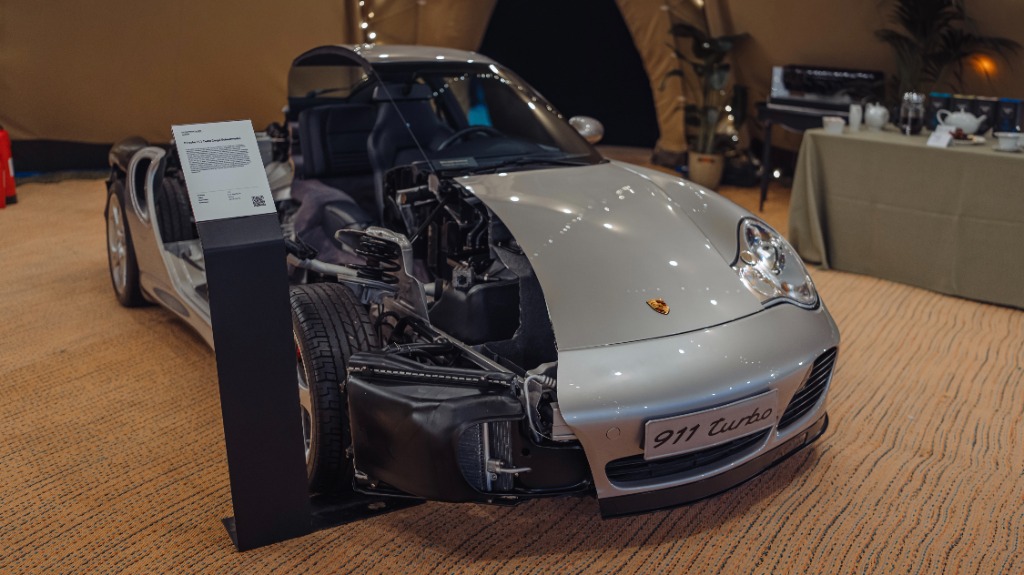
Official Porsche Museum cutaway showing the vulnerable low-slung placement of water radiators and AC condensers inside the front bumper.
Source : © Porsche AG
6. PIWIS Diagnostic Report (Overrevs & Mileage Plausibility)
A mandatory step when buying any modern water-cooled Porsche. Have a Porsche dealer or specialist run a DME scan via the PIWIS diagnostic tool:
- Overrev Ranges (Range 1 & 2) : On 996-generation cars, the ECU only logs overrevs across two ranges (unlike the 6 ranges on 997+ models). Range 1 records engine speed hits against the rev limiter during acceleration (harmless). Range 2 is critical: it logs mechanical overrevs caused by money-shifts (missed downshifts), which can bend valves or stress valve springs. The report displays Range 2 ignitions and the exact engine operating hour when it occurred. If a Range 2 occurred within the last 50 operating hours, exercise extreme caution. If it occurred hundreds of hours ago and the engine runs smoothly, it survived unscathed.
- Operating Hours Plausibility : Divide total odometer mileage by the total DME operating hours to calculate average lifetime speed. For typical mixed driving, average speed ranges between 25 and 35 mph (40–60 km/h). An unnaturally low average speed (<15 mph) on a low-mileage car may indicate rolled-back mileage. Conversely, a very high average (>45 mph) points to heavy highway or track use.
7. How to Verify a Genuine X50 Package or Turbo S
Given the 15% to 25% market premium for 444-hp models, counterfeit “clones” exist. Always verify authenticity:
- Option Code Sticker : Located under the front hood (frunk) and inside the original service booklet. Look for code X50 (powerkit) or 996 Turbo S (2005 only) along with code I450 (PCCB ceramic brakes).
- Turbocharger Part Numbers : Inspect the turbos on a lift. The riveted data plates must state K24 (instead of standard K16). Original X50 Porsche part numbers are
996.123.013.72(left) and996.123.014.72(right). - GT2 Intercoolers : X50 and Turbo S models use thicker GT2 intercoolers with rougher end-tanks, tactile through the side air scoops. Porsche part numbers are
996.110.639.51and996.110.640.51. - Model Year Check : Genuine 996 Turbo S models were produced exclusively for MY2005. Never buy a 2001–2004 car represented as a “factory Turbo S”.
- Vehicle Master Inquiry (VMI) : Ask an authorized Porsche dealer to pull the VMI printout using the VIN to confirm original factory build specs.
Investment Outlook
For smart capital allocation, myDriveROI’s strategy is clear:
- Target the Factory 6-Speed Manual First (Getrag G96/50) : As analyzed in our report on how transmission choice impacts vehicle valuation, a manual gearbox is the single most important investment metric. Tiptronic automatics suffer a 20% to 30% discount and lack long-term collector upside. Two body style strategies emerge:
- The Rational Play (Coupe) : The classic choice for pure lines and uncompromised torsional rigidity. It is the most liquid asset in the market today.
- The Speculative Play (Cabriolet – 4,389 units) : Introduced late in the run (MY04), the Cabriolet is physically rare (just 20% of Turbo production, including 963 Turbo S cabs). Discounted historically by 10%–15% due to track-use perceptions, the Cabriolet is ripe for a valuation catch-up. In the “Modern Classic” era, the open-air experience of hearing the Mezger flat-six and K24 turbos spooling overcomes lap-time arguments for real-world enthusiasts.
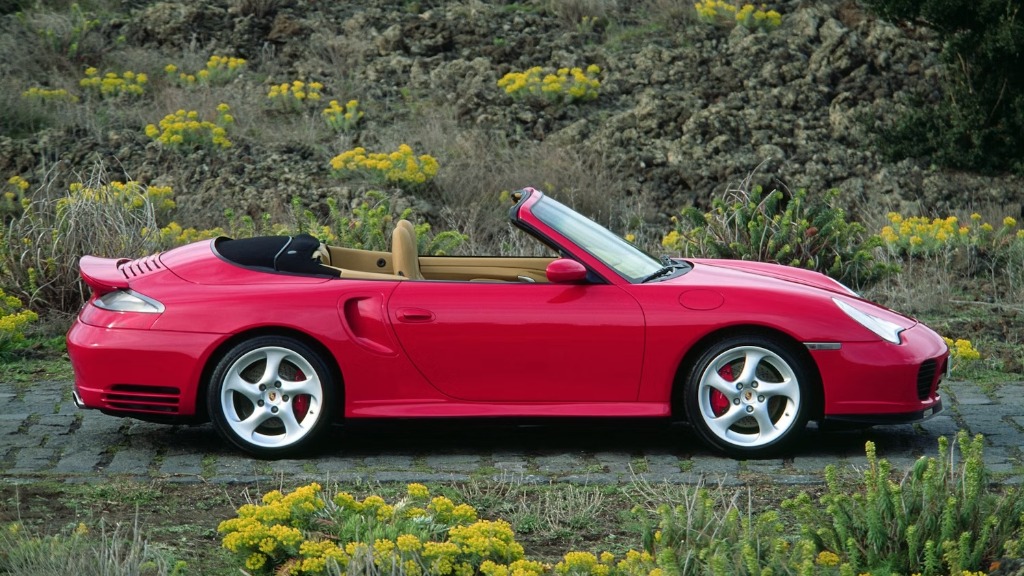
The Porsche 911 (996) Turbo Cabriolet: a low-production rarity (4,389 units) with strong growth upside as a Modern Classic.
Source : © Porsche AG
- Prioritize Factory X50 & MY2005 Turbo S Models : These 444-hp variants feature factory GT2 hardware and command enduring collector premiums.
- Value Verified Mechanical Bulletproofing : A documented history confirming pinned/welded coolant lines and a serviced rear spoiler adds immediate tangible value to any purchase.
- Market Price Anomaly vs. 993 and 997 Turbos : As shown in the comparative table below, the 996 Turbo represents an incredible value proposition given its performance and heritage:
| Model & Generation | Engine Specs | Global Production | Average US Market ($) | Average EU Market (€) | Investment Position / Take |
|---|---|---|---|---|---|
| 993 Turbo (1995–1998) |
3.6L Twin-Turbo (Air-cooled) 400 hp SAE / 398 lb-ft |
~5,937 units | $180,000 – $350,000+ | 150 000 € – 280 000 €+ | Blue-Chip Icon. The final air-cooled Turbo. Extreme rarity, prices solidified at the top. |
| 996 Turbo (2001–2005) |
3.6L Mezger (Water-cooled) 415 hp SAE / 413 lb-ft |
~21,954 units (Coupe: 16,965 Cabriolet: 3,426 Turbo S Coupe: 600 Turbo S Cab: 963) |
$60,000 – $110,000 | 55 000 € – 95 000 € | The Turbo Value Sweet Spot (Severely Undervalued). Bulletproof Mezger engine. Accessible entry price for a manual coupe. |
| 997.1 Turbo (2007–2009) |
3.6L Mezger (Water-cooled, VTG) 473 hp SAE / 460 lb-ft |
~18,200 units | $85,000 – $140,000 (Manual) | 75 000 € – 120 000 € (Manual) | The Last Manual Mezger. Aggressive buyer demand for 6-speed manuals. Steady appreciation trajectory. |
| 997.2 Turbo (2010–2013) |
3.8L DFI (Direct Injection, Non-Mezger) 500 hp SAE / 480 lb-ft |
~5,000 units | $110,000 – $170,000 | 95 000 € – 150 000 € | Rarer But Less Analog. Introduced PDK dual-clutch and DFI engine. Blistering GT speed, modern feel. |
👉 To deepen your investment knowledge, explore our related guides: How transmission choice impacts car values, Managing complex maintenance risks, and Anticipating market bottoms for maximum ROI.
Car Evaluation
Evaluation Criteria
Appreciation Potential
Potential for value increase over time
"The 996 Turbo is one of the most undervalued 911 Turbos on the market. Powered by the legendary Mezger engine—free from the IMS bearing flaws of base Carreras—its current price (~$75,000 for an original manual coupe) is remarkably low compared to the 993 Turbo and even manual 997 Turbos. Growing demand for analog driving feel and bulletproof mechanics will drive values up over the long term."
Ownership Cost
Total cost of ownership including maintenance, insurance, and running costs
"The Mezger engine is exceptionally robust, but maintaining a 20+ year old 911 Turbo demands a disciplined budget. Known weak spots (coolant pipe pinning/welding, hydraulic rear wing) require substantial labor costs. Once bulletproofed, however, it is an extraordinarily reliable daily-drivable supercar."
Driving Pleasure
Pure driving enjoyment and emotional connection
"The 3.6L Mezger twin-turbo delivers a phenomenal 415 hp punch with an unmistakable old-school character. Its wheelbase, extended to 92.6 in (2,352 mm) compared to the 993 Turbo, provides supreme high-speed stability while retaining a pure, ultra-communicative hydraulic steering rack. The 6-speed Getrag manual and viscous-coupling AWD complete a sublime dynamic package."
Market Liquidity
Ease of selling when needed
"Liquidity is excellent for coupes equipped with the factory 6-speed manual transmission, highly sought after by purists. Conversely, cabriolets and 5-speed Tiptronic automatics suffer a steep valuation discount and take considerably longer to sell."
Exclusivity & Rarity
How rare and exclusive the vehicle is
"With 21,954 units produced globally across all variants, it is not ultra-rare overall. However, original 6-speed manual coupes in factory condition with complete service history are increasingly scarce and command significant market premiums."
Similar Cars
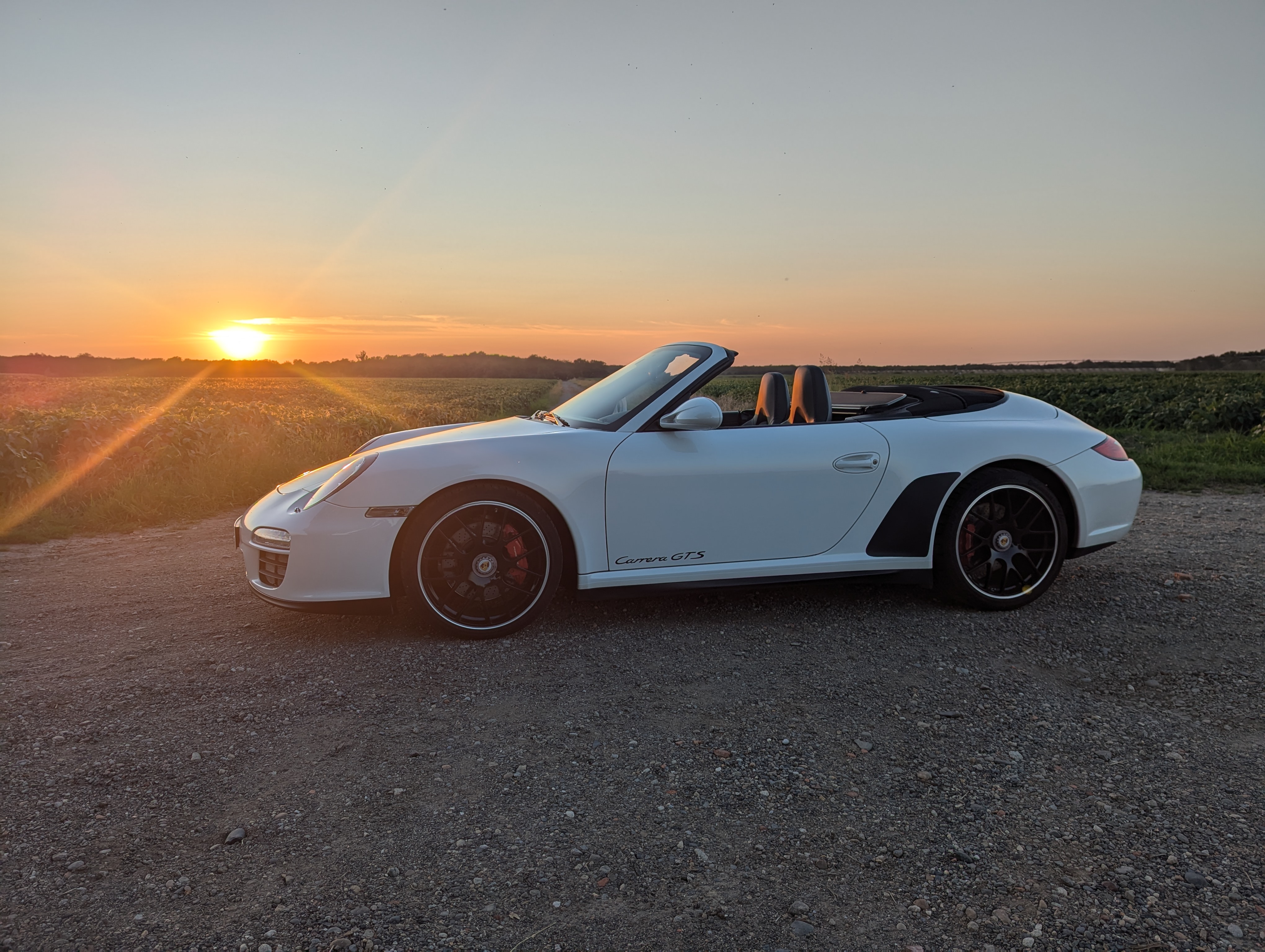
Porsche 911 (997) Carrera GTS manual: The Forgotten Gem
Porsche 911 (997) Carrera GTS
Porsche 911 (992.2) Carrera T: A Brand-New Gem in the Lineup
Porsche 911 (992.2) Carrera T
Porsche 911 Carrera 3.0: The Forgotten Gem Ready for Its Market Comeback
Porsche 911 Carrera 3.0
Related Articles