BMW M5 E39: The Best M5, Perhaps the Best BMW Ever Made

Specifications
Basic Information
Performance & Value
The myth of the sports sedan arguably reached its peak at the end of the 1990s, on the assembly floor in Dingolfing. The BMW M5 E39 is not simply a fast car; it embodies the absolute pinnacle of the compromise between grand touring refinement and a mechanical purity that modern production vehicles so sorely lack. Often imitated, never truly equaled, it represents the golden analog era of Motorsport.
Positioning: The Historical Sweet Spot
Source: © myDriveROI.com
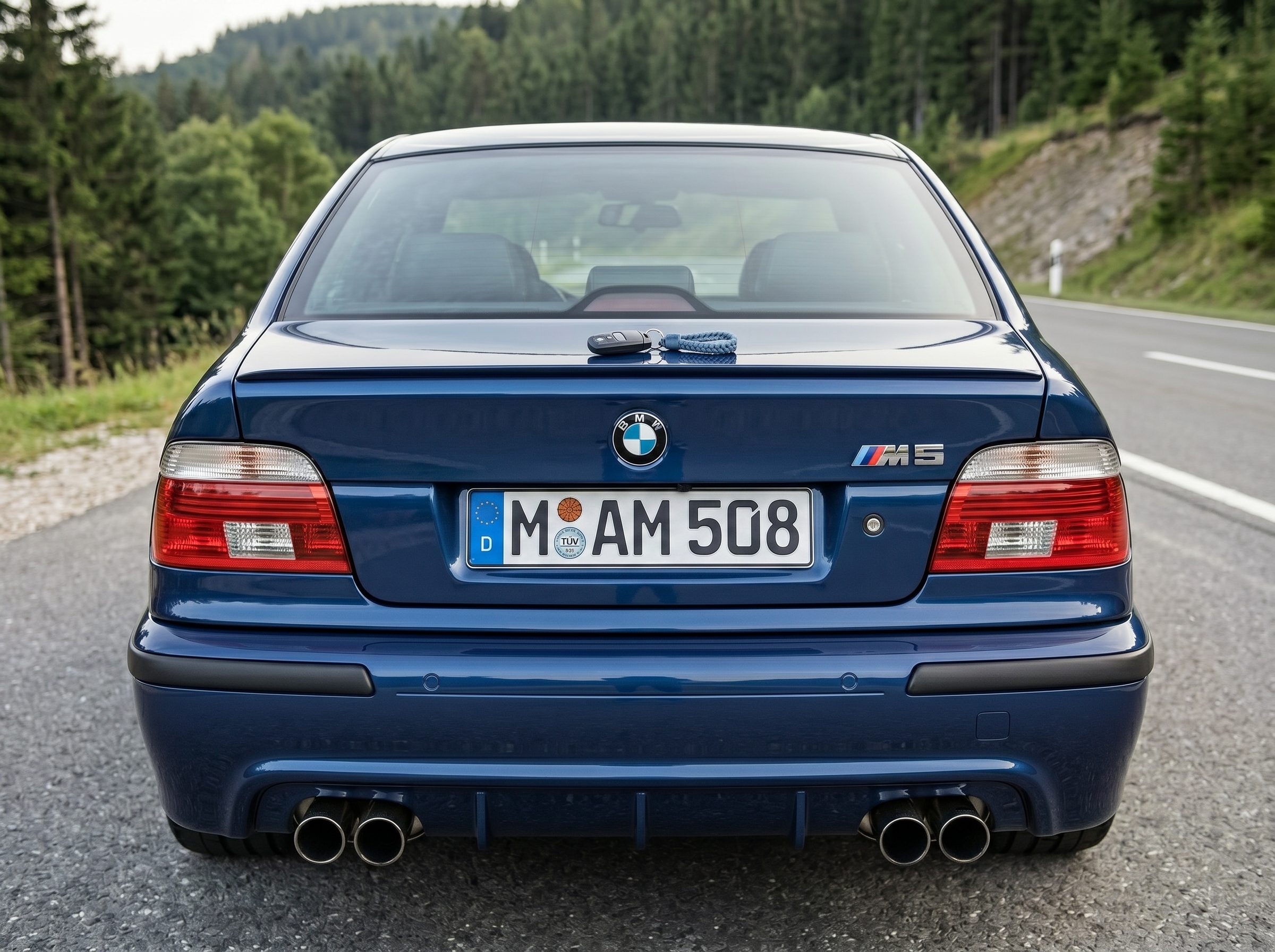
To understand the M5 E39, you need to look at what surrounds it. Produced in approximately 20,482 units (including ~7,895 left-hand-drive examples for the European market), it marks a pivotal chapter for the Motorsport division.
- Before it, while the M3 E36 had already opened the door to high-volume production (~71,242 units), the lineage of M5 grand tourers had remained niche, almost hand-built vehicles — like the M5 E34 (~12,200 units).
- After it, M became synonymous with mass production, flooding the market with models like the M3 E46 (~85,000 units) or the M3 E92 V8 (~65,000 units).
The E39 thus represents the perfect equilibrium: a massive global success for Motorsport, yet with production volumes that make it, today, infinitely more exclusive and difficult to find in pristine condition than the M3 E36 that came before it, or its modern successors.
Design: Quiet Strength
Source: © myDriveROI.com
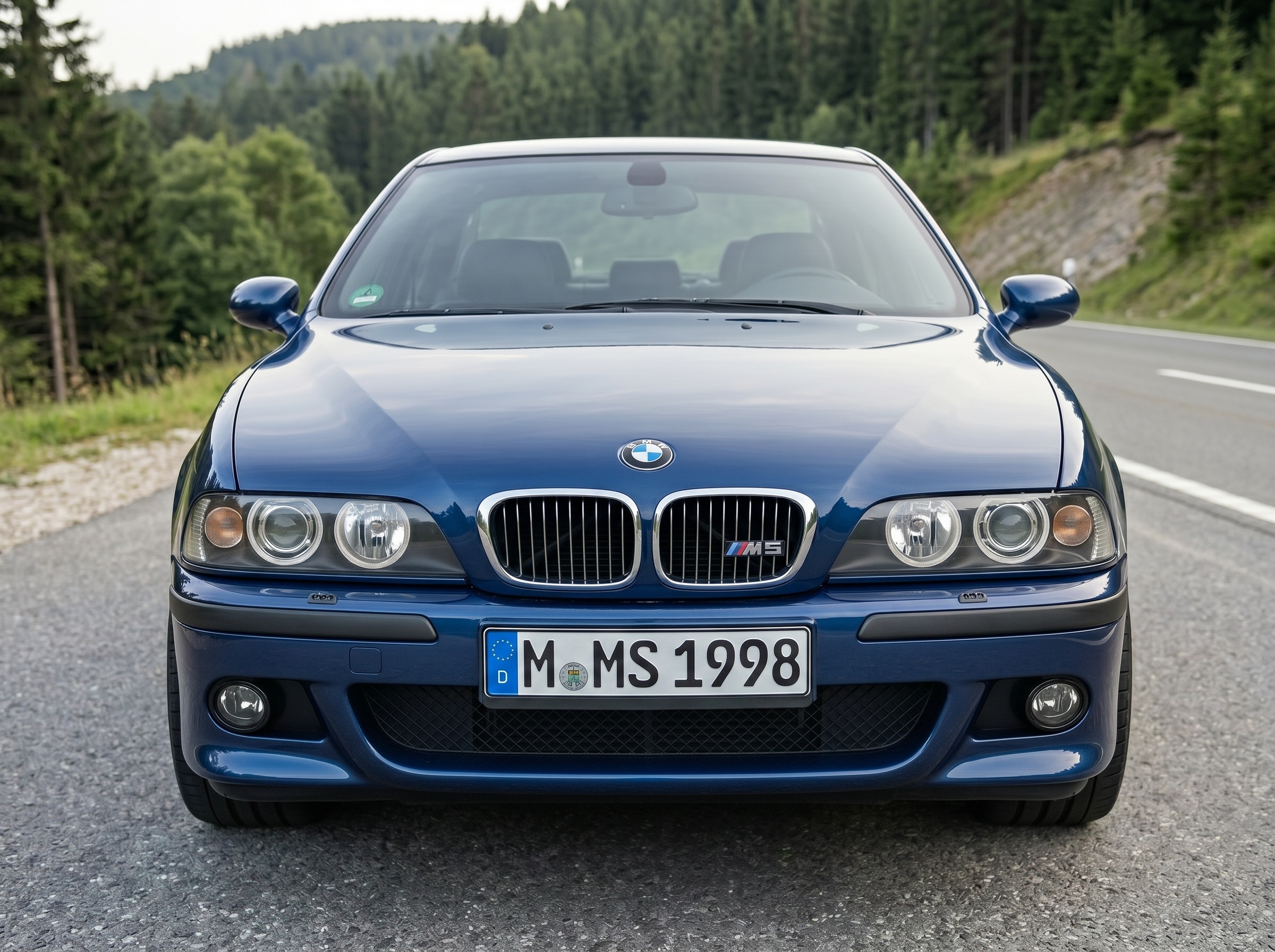
For many BMW enthusiasts, the E39 generation is considered the most successful 5 Series ever produced, both for its exterior styling and its interior build quality. A masterpiece of the pre-Bangle era, the M5 version intensifies this quintessence by mastering the art of muscular restraint. No ostentatious wings, no caricatured aerodynamic add-ons. Connoisseurs will identify it by its superb 18-inch “Style 65” wheels, its distinctive oval-shaped side mirrors, and of course, four exhaust outlets seamlessly integrated into the rear diffuser. It is timeless elegance capable of blending into any crowd — the very definition of a “Sleeper.”
The LCI (Life Cycle Impulse) models, introduced for the 2001 model year, are the most sought-after, thanks to the addition of the iconic “Angel Eyes” front headlights (luminous rings) that modernized the car’s face, along with LED taillights at the rear.
Interior: Executive Velvet
Source: © BMW Group
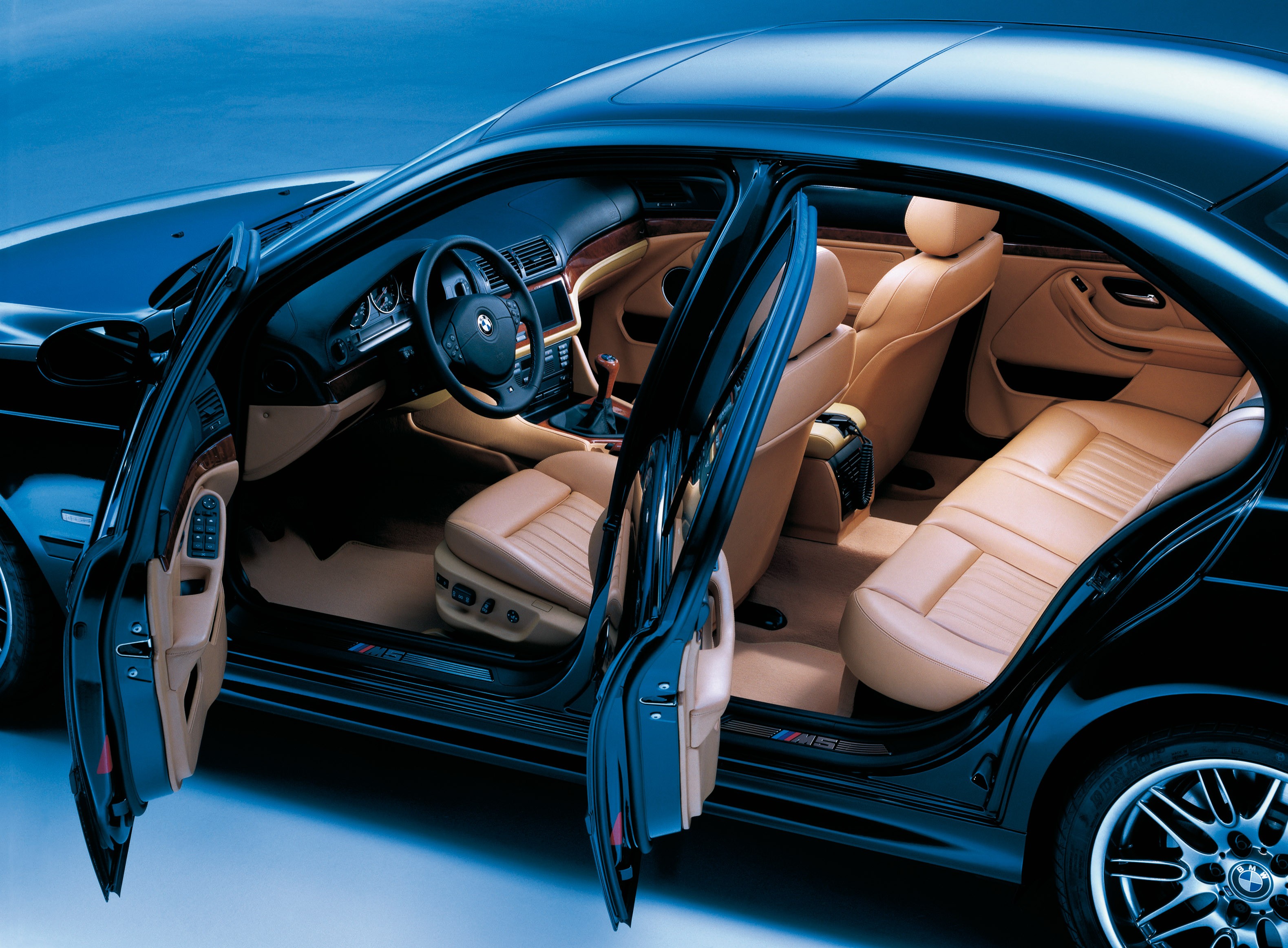
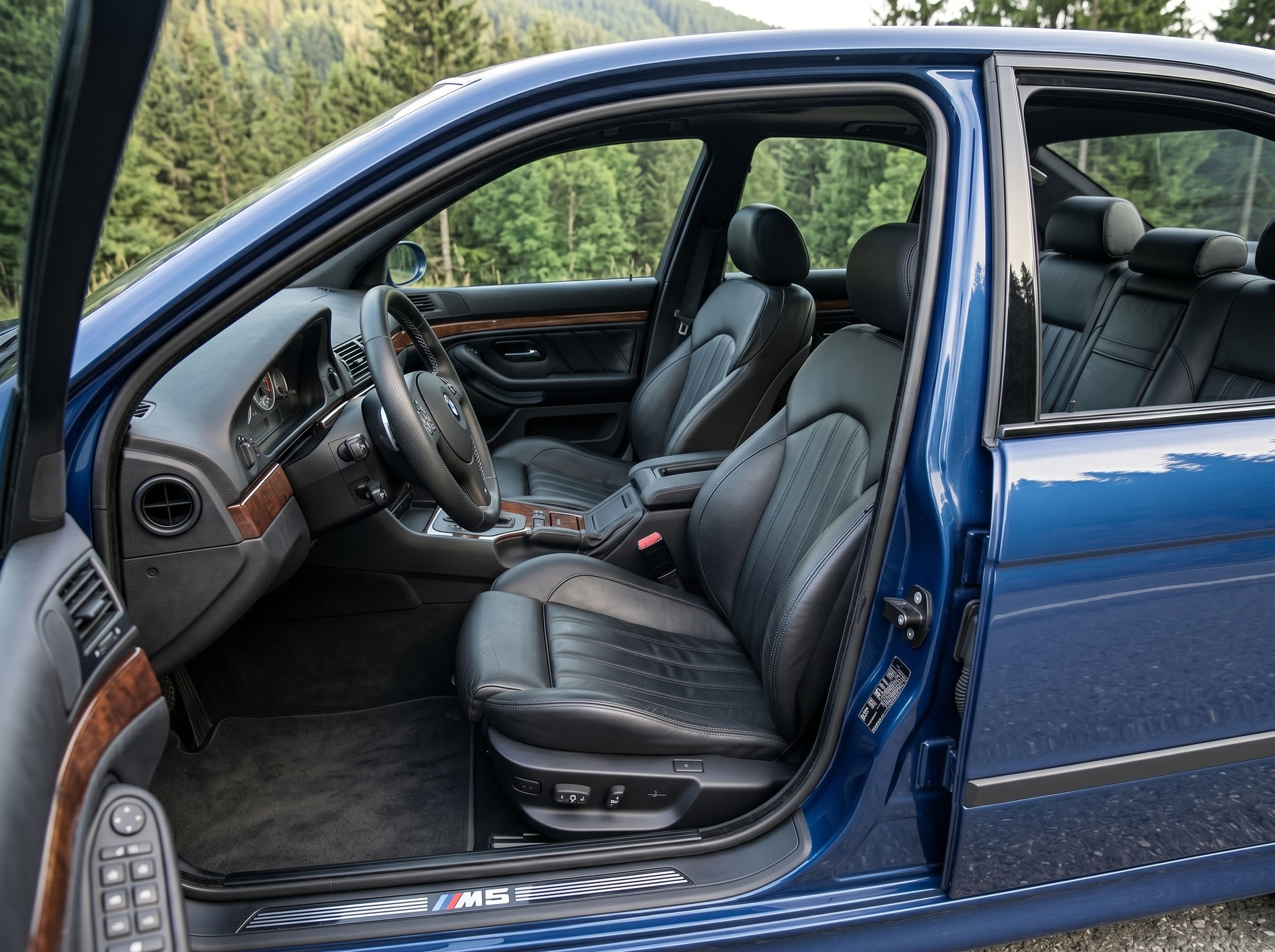
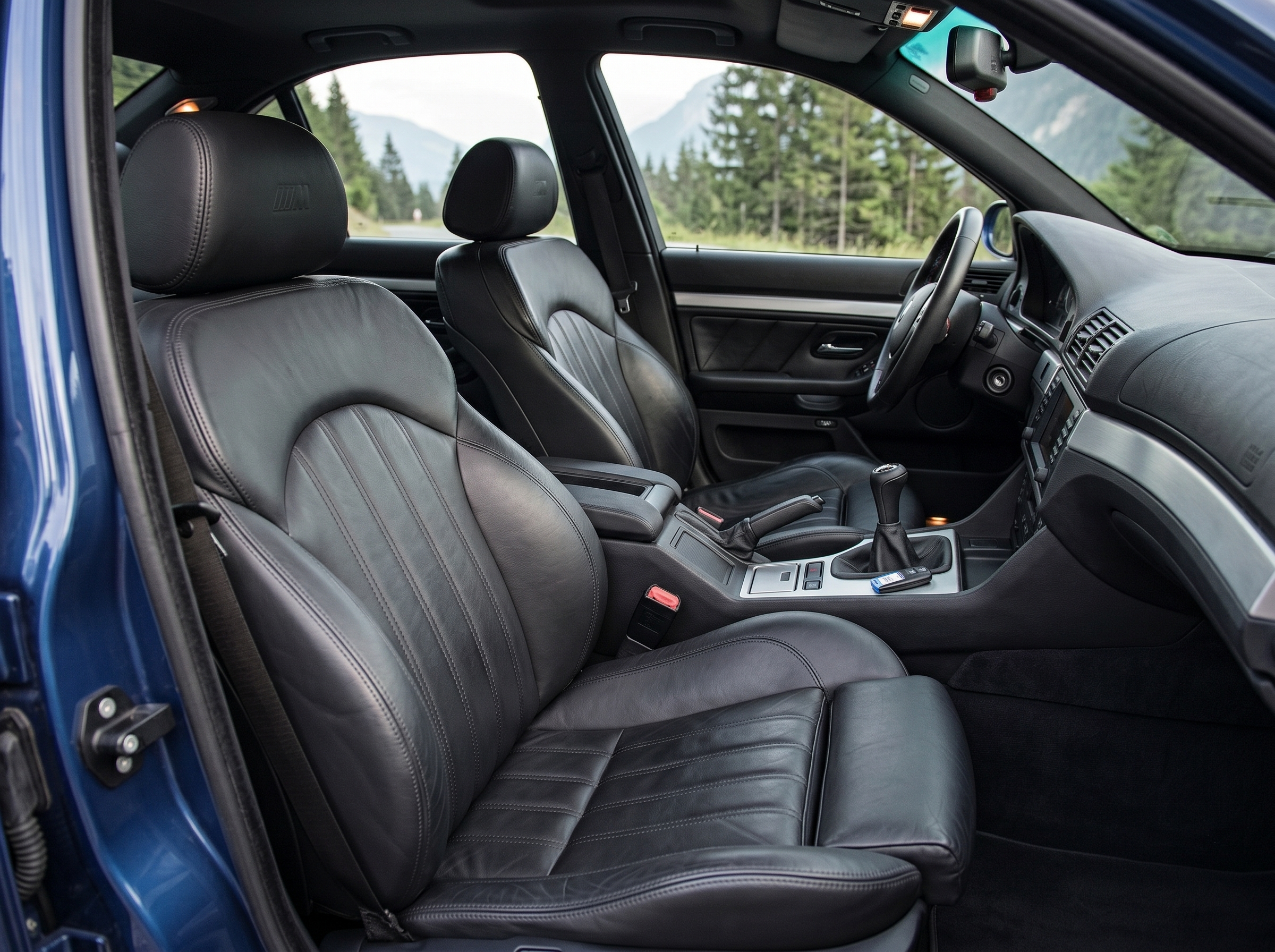
Settling into the driver’s seat of an M5 E39 is stepping into an executive lounge from the early 2000s. The quality of the trim, the soft-touch plastics, the genuine wood or aluminum accents, and above all the thickness of the full leather upholstery, all serve as a reminder that the 5 Series has always been designed to deliver commanding comfort. That signature smoothness, typical of BMW’s top-tier sedans, insulates occupants from road imperfections and exterior noise with rare refinement. Yet the classic instrumentation — M-specific gray gauge faces and the LED ring around the tachometer indicating engine warm-up — never lets you forget the vehicle’s true calling.
Powertrain: The Legendary S62 (Dr. Jekyll and Mr. Hyde)
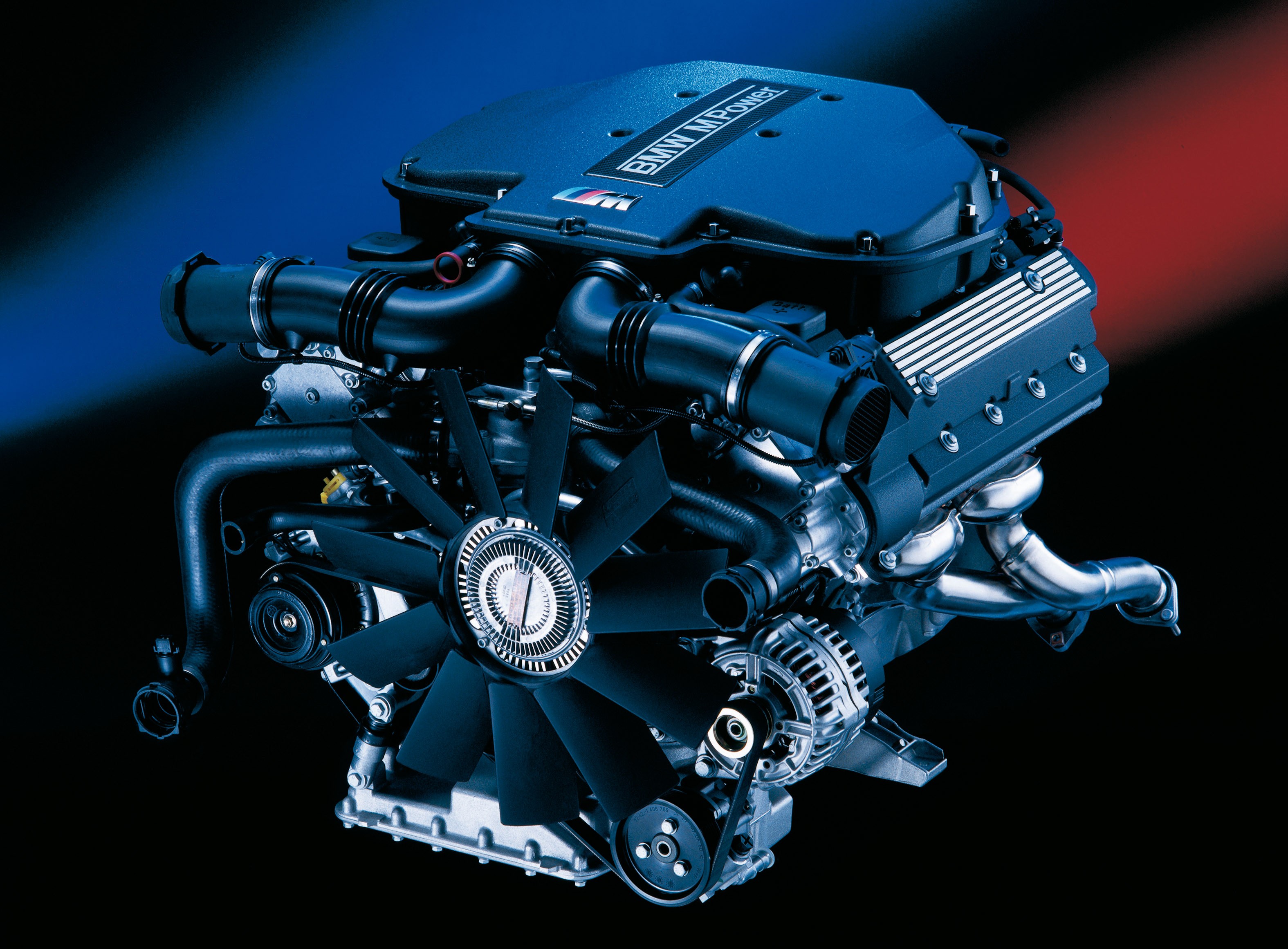
At the heart of the beast sits the S62: a 4.9-liter naturally aspirated V8 developing 400 horsepower and 369 lb-ft of torque, crowned by its spectacular Motorsport cylinder heads. This engine is the key to the M5 E39’s split personality:
- Dr. Jekyll: At low revs, it is silky smooth, torque-rich, allowing effortless cruising in fifth or sixth gear in near-silent composure, perfectly complementing the cabin’s luxurious isolation.
- Mr. Hyde: When you bury the throttle, all eight individual intake throttle bodies snap open, the exhaust note turns cavernous, almost feral, and the engine charges toward the redline with relentless ferocity.
Source: © BMW Group
And the element that elevates this powertrain to legendary status is the Getrag 6-speed manual gearbox — the only transmission option available from the factory. The obligation to work a clutch and a firm, precise shifter within such a refined environment delivers a level of driver involvement that has become extraordinarily rare.
On the Road: Queen of the Autobahn
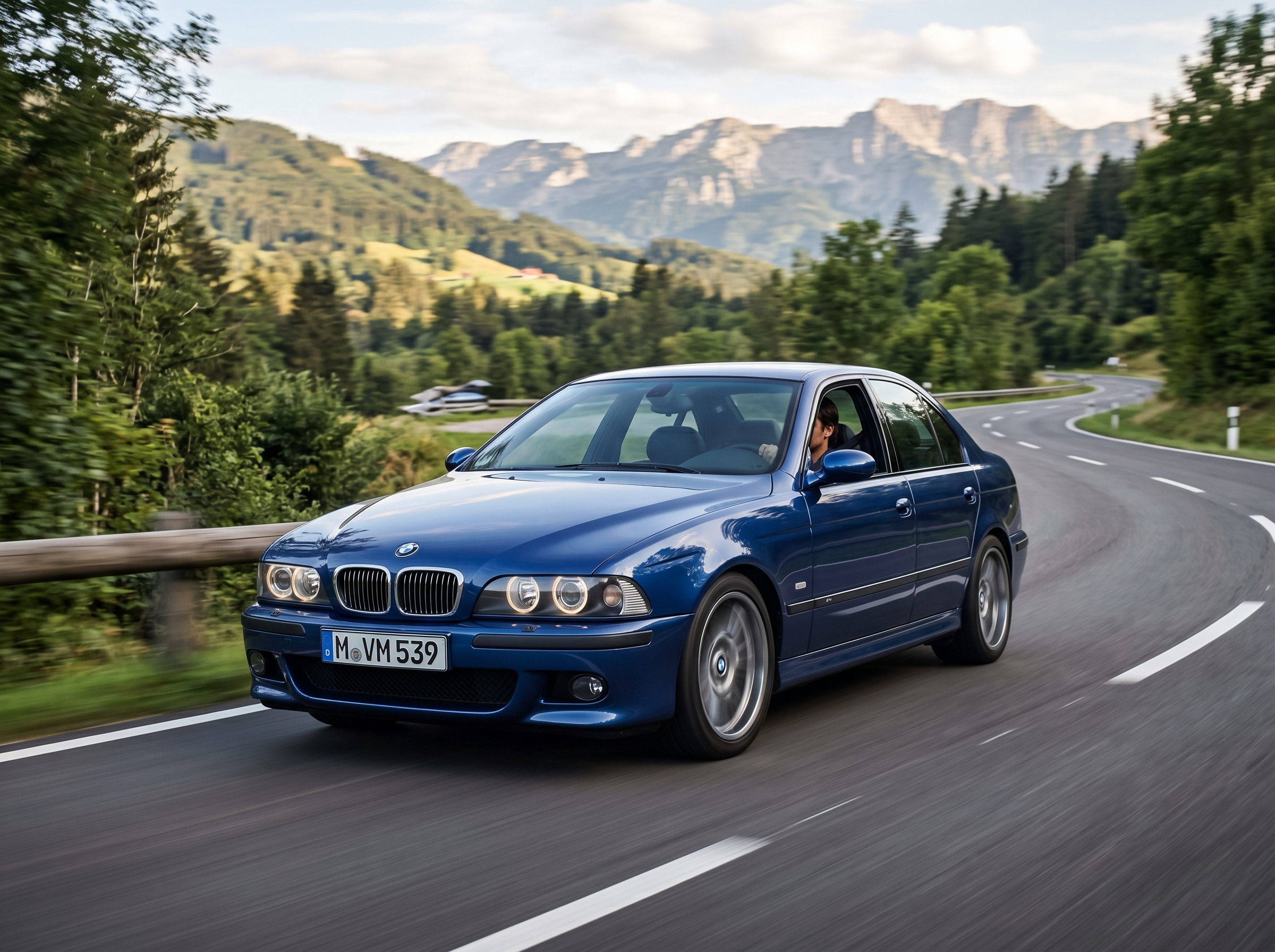
The chassis balance BMW achieved with the E39 borders on genius. The suspension never sacrifices ride comfort in the name of sportiness. It absorbs road imperfections without drama, while keeping the car’s mass under iron-fisted control through corners.
Source: © myDriveROI.com
Unlike previous M5 generations equipped with inline-six engines, the V8’s bulk forced BMW to use a recirculating ball steering system rather than a rack-and-pinion setup. While the steering is sometimes considered very slightly less razor-sharp than on a standard 5 Series, it delivers consistent, accurate feedback, making this rear-wheel-drive machine surprisingly intuitive and rewarding to place. Brake endurance is the one genuine weak point: the factory brakes are underdimensioned relative to the S62’s 400 horsepower, and an upgrade to higher-grade calipers and rotors is strongly recommended to match the car’s performance potential.
Reliability and Running Costs: The Other Side of the Coin
This is where complete honesty is required. The S62 V8 is a very robust engine when meticulously maintained, but the “M Tax” is very real.
- The VANOS system: The variable valve timing system is the primary maintenance concern on this engine. Failures (seals, solenoids) are complex and expensive to repair.
- Rod bearings: As is common with Motorsport engines of this era, preventive replacement (every 60,000 to 90,000 miles) is strongly advised to avoid catastrophic engine failure.
- Ancillaries: The mass airflow (MAF) sensors are fragile, the clutch can suffer under the assault of 369 lb-ft of torque, and chronic electrical gremlins — notably the disappearing pixels on the central dashboard display — are commonplace.
- Corrosion: A crucial inspection point on the body shell, particularly around the rear jacking points, which can require expensive structural repairs.
Source: © myDriveROI.com
Maintenance allows zero compromise, and a cheap example with no service history will inevitably become a money pit. That said, with rigorous upkeep, this drivetrain proves extremely durable and will carry you to very high mileage — a considerable advantage over its direct successors: the M5 E60 is notoriously plagued by catastrophic failures of its SMG automated gearbox and the inherent weaknesses of its naturally aspirated V10, while the following F10 generation and its twin-turbocharged S63 V8 carries a reputation for fragility and prohibitively expensive turbo and timing chain overhauls. The E39, by contrast, has the advantage of relative mechanical simplicity. Naturally, for this type of investment, modified cars must be avoided at all costs: factory configuration must be scrupulously preserved — with one exception: the stock brakes, undersized for the S62’s output, genuinely deserve an upgrade to superior calipers and rotors.
Production Numbers and Scarcity
As previously noted, with just over 20,000 units leaving the assembly line, the M5 E39 is not “rare” in a purely statistical sense. Its successors (M3 E46 or E92) were produced in far larger quantities (between 65,000 and 85,000 units), while its predecessors (E28 or M635CSi) never exceeded a few thousand examples.
Here is a comparative table positioning the M5 E39 within contemporary “M” production:
| Model | Years | Global Production | Average Value (Good Condition) | Market Trend |
|---|---|---|---|---|
| M5 (E34) | 1988 - 1995 | ~ 12,254 | $34,000 - $40,000 | Stable, strong premium for the rare Touring wagon. |
| M3 (E36) | 1992 - 1999 | ~ 71,242 | ~$38,000 | Rising; original, unmodified examples are extremely hard to find. |
| 👉 M5 (E39) | 1998 - 2003 | ~ 20,482 | $33,000 - $43,000 | Stable. Strong premium for original Phase 2 examples. |
| M3 (E46) Coupe | 2000 - 2006 | ~ 85,744 | $38,000 (SMG) - $49,000 (Manual) | Highly sought after but abundant. Large manual gearbox premium. |
| M5 (E60) V10 | 2005 - 2010 | ~ 20,548 | ~$38,000 | Strong depreciation on worn SMG cars. Massive premium for manuals. |
| M3 (E92) V8 | 2007 - 2013 | ~ 65,000 | ~$49,000 | Rising; highly desirable for its naturally aspirated V8. |
Its scarcity on the current market is structural and qualitative. Due to its age and ownership costs, a large number of examples were poorly maintained, modified, or damaged during the 2010s. Today, finding a strictly stock M5 E39 with a clean, documented history and reasonable mileage is genuinely challenging.
mydriveROI Verdict
The 5 Series has always been one of the finest grand tourers in the world, and the E39 generation is, for many, its most accomplished expression — the one that best combined sovereign driving refinement with exceptional dynamic ability. The M5 E39 pushes this quintessence to its absolute limit: a driving character so particular, so complete, that it is fundamentally difficult to grasp until you have driven one. No spec sheet, no comparison test can truly convey what it feels like from behind the wheel.
Source: © myDriveROI.com
It is precisely for this reason that the M5 E39 is, in the eyes of many, the greatest BMW ever built — and why it will always command exceptional appeal on the collector market. Investing in a beautiful, meticulously documented example (ideally a Phase 2) is acquiring far more than a sports sedan: it is owning a raw diamond from the analog era, whose value is continuously reassessed as the modern automobile marches inexorably toward electrification and sensory sterility.
Car Evaluation
Evaluation Criteria
Appreciation Potential
Potential for value increase over time
"Widely regarded as the greatest M5 in history, the E39's market value surged before stabilizing at its current level. Clean, original examples with a well-documented history represent a solid investment, as the supply of pristine specimens continues to shrink."
Ownership Cost
Total cost of ownership including maintenance, insurance, and running costs
"The Achilles' heel of this masterpiece. Maintaining the S62 V8 (VANOS system, rod bearings) and the vehicle's overall mechanical complexity demand a significant budget. The 'M Tax' is very real."
Driving Pleasure
Pure driving enjoyment and emotional connection
"The perfect compromise. Business-class smoothness and comfort at low speeds, transforming into raw mechanical ferocity (naturally aspirated V8 + manual gearbox) the moment you push harder. An analog, deeply engaging machine."
Market Liquidity
Ease of selling when needed
"Demand for clean, unmodified examples is very strong. A car with solid provenance will sell quickly, while a 'tired' specimen will scare off knowledgeable buyers."
Exclusivity & Rarity
How rare and exclusive the vehicle is
"With just over 20,000 units produced, it is not absolutely rare by volume. Its true rarity today lies in the exceptional state of preservation of certain surviving examples."
Similar Cars
Related Articles