Ferrari F355: The Apex of Maranello's Analog V8

Specifications
Basic Information
Performance & Value
The End of an Era and the Birth of a Legend
Introduced at the 1994 Geneva Motor Show to succeed the disappointing 348, the Ferrari F355 marked a historic turning point for Maranello. Under the direction of Luca di Montezemolo, Ferrari had to not only deliver a higher-performing sports car, but also correct the build quality flaws and tricky handling behavior of its predecessor. The result was a revelation: a line of rare elegance penned by Pininfarina, combined with Formula 1-derived technology.
Today, the F355 is considered the ideal missing link: it retains the compact dimensions, aesthetic purity, and communicative hydraulic steering of older cars, while still offering performance that feels entirely contemporary. It is the archetype of the “Modern Classic” collector car.
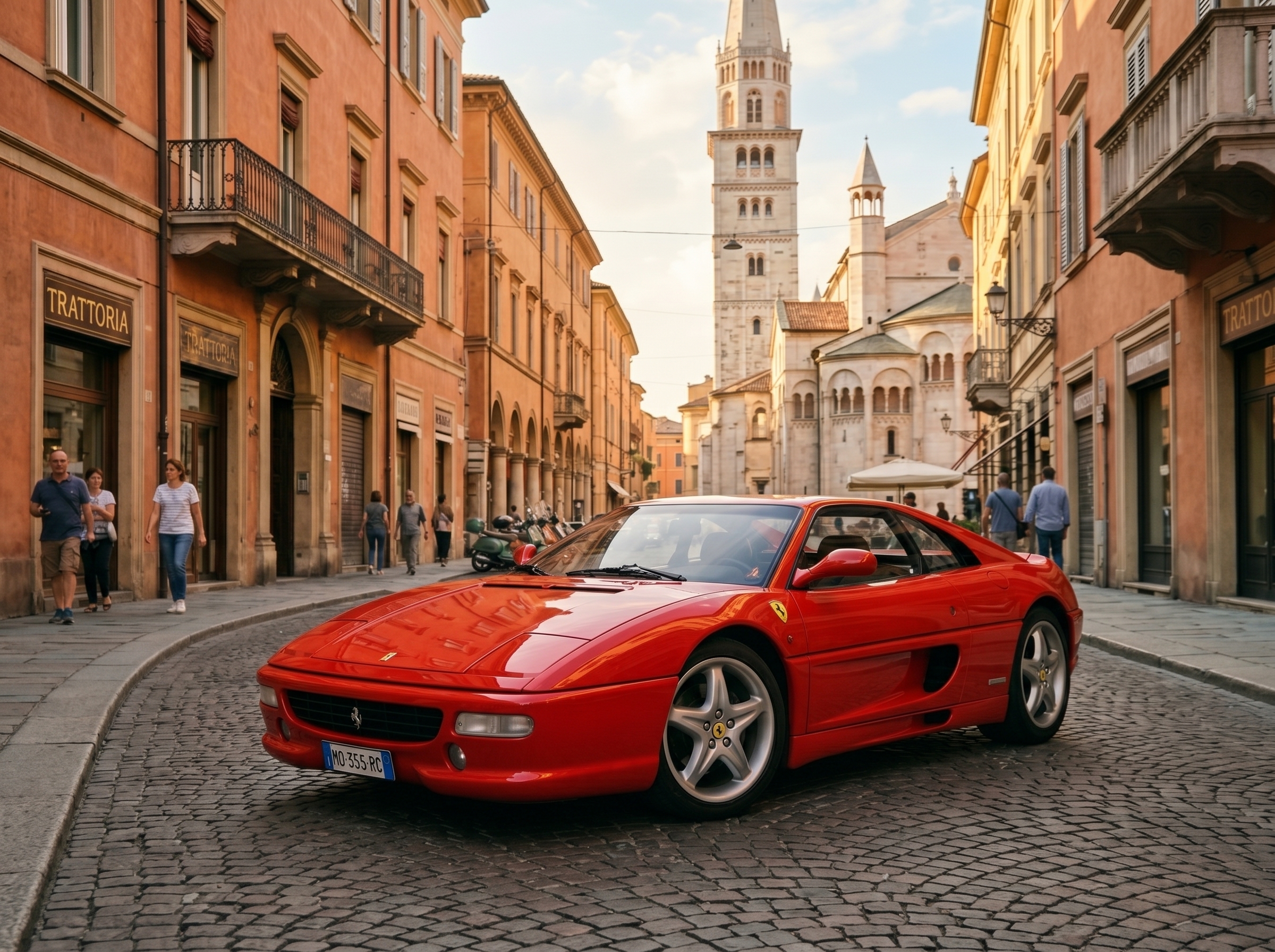
The Ferrari F355 Berlinetta, a timeless masterpiece.
Design: Pininfarina’s Absolute Masterpiece
Aesthetically, the F355 is considered by many to be one of the most beautiful Ferraris of the modern era. It represents the peak of 1990s Pininfarina style, successfully blending aggressiveness and elegance without any ostentatious aerodynamic appendages.
The taut lines, pop-up headlights (which give it an incomparable silhouette when retracted), and sculpted side air intakes recall the legendary 512 TR while refining the proportions. Unlike current models dictated by complex aerodynamic flow constraints, the F355 boasts an elegantly clean road presence. It is this timeless design that allows it today to escape the status of a “used Ferrari” and establish itself as a true collector’s masterpiece.
Interior: Sobriety and Connolly Leather Against the Test of Time
Inside, the F355 cabin is a model of simplicity and driver-focused ergonomics. The dashboard, wrapped in Connolly leather renowned for its fine texture, sits in front of classic round analog gauges that offer perfect readability. The driving position is typical of the era, requiring slightly bent legs but placing the gated manual shifter perfectly under the right hand.
However, life inside an F355 requires dealing with materials that sometimes age poorly:
- Sticky plastics: The bane of interiors from this era. The soft-touch coating on the center console buttons, air vents, and switchgear degrades into a black, sticky mess. Fortunately, independent specialists can now clean and restore these parts to like-new condition.
- Connolly leather dashboard: Under the effects of UV rays and temperature fluctuations, the leather near the windshield and air vents has a tendency to shrink and pull apart.
Despite these flaws, build quality is a major step up from the 348, and the simplicity of this screen-free interior contributes greatly to the car’s analog driving experience.
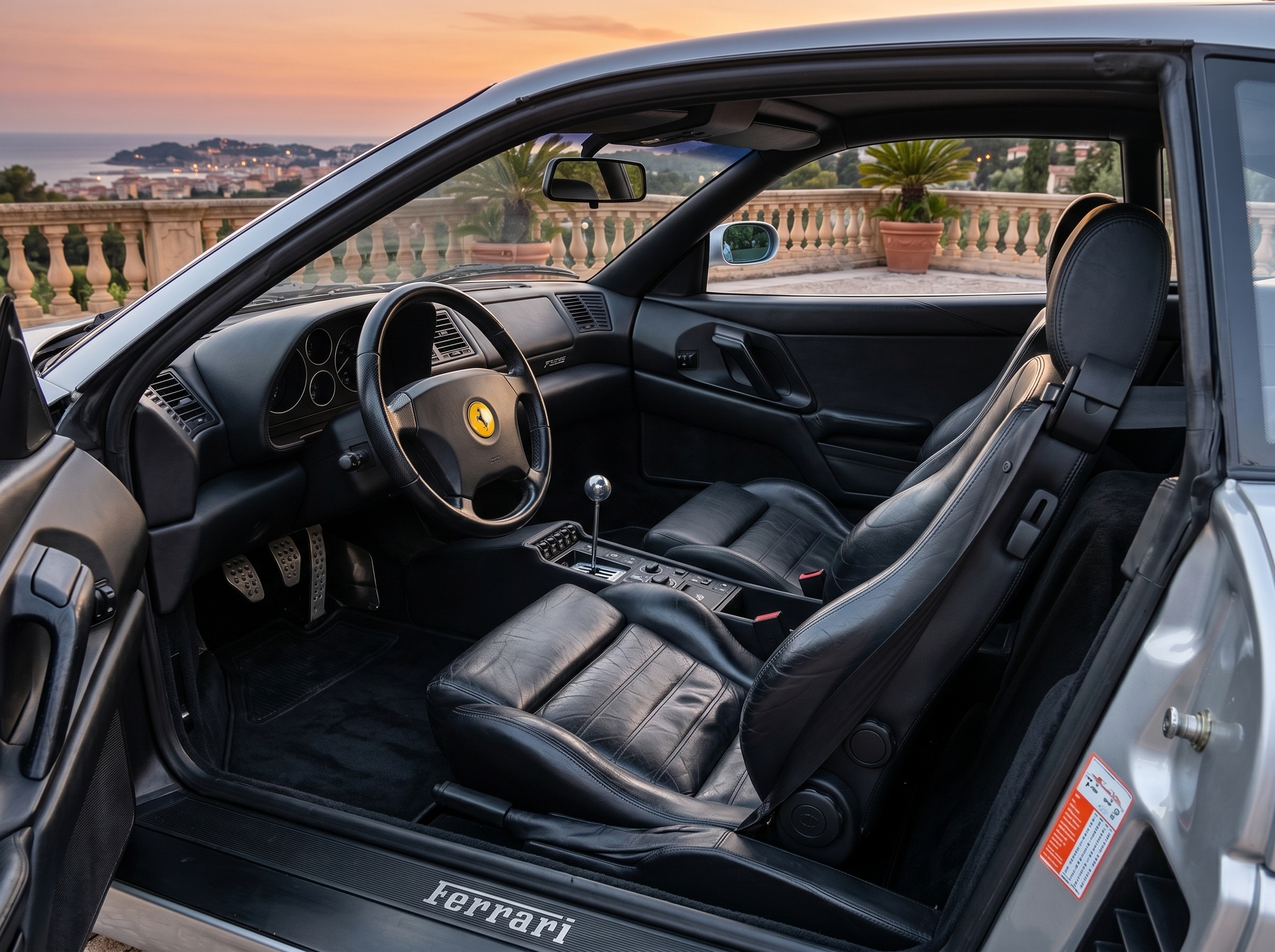
The clean and timeless cabin of the Ferrari F355 featuring its famous gated manual shifter.
Mechanical: The Craftsmanship of 5 Valves Per Cylinder
Under the engine cover (which opens to reveal a particularly beautiful bay with red-painted intake manifolds), the 90° 3.5L V8 (Type F129) is a piece of high technology. It is characterized by its cylinder head featuring 5 valves per cylinder (three intake, two exhaust), a solution directly derived from Ferrari’s Formula 1 program.
This naturally aspirated engine develops 380 horsepower at 8,250 rpm and 363 Nm of torque at 6,000 rpm, achieving an exceptional output of 109 hp/liter. Equipped with a dry sump and Bosch Motronic electronic fuel injection, this engine possesses a dual personality. Docile and smooth around town below 4,000 rpm, it transforms into a lyrical monster past that point, with the opening of the bypass valve releasing a metallic scream worthy of a 1990s Formula 1 car all the way to its 8,500 rpm redline.
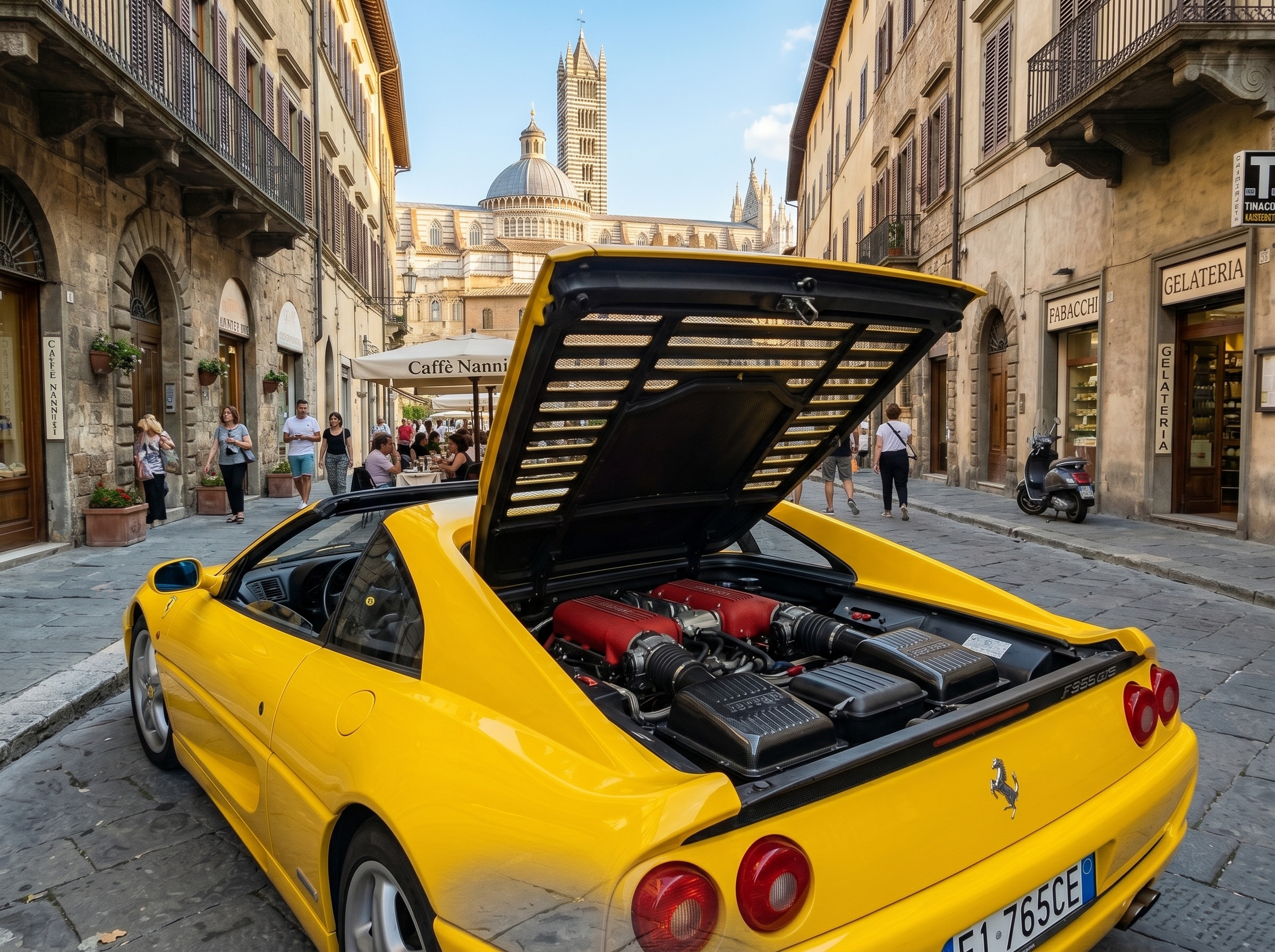
The splendid naturally aspirated 3.5L V8 producing 380 horsepower.
Evolution: Bosch Motronic 2.7 vs 5.2
During production, the electronic management evolved:
- Motronic 2.7 (1994-1995): This system uses two separate mass airflow sensors and dual ECUs. The engine breathes more freely, offering sharper throttle response and a wilder character. These models lack airbags and feature the beautiful three-spoke sport steering wheel.
- Motronic 5.2 (1996-1999): Introduced to meet OBDII standards (notably for the US market), this system uses a single airflow sensor and a Y-shaped intake manifold. The engine behavior is slightly smoother, and the cabin receives a four-spoke steering wheel with an airbag.
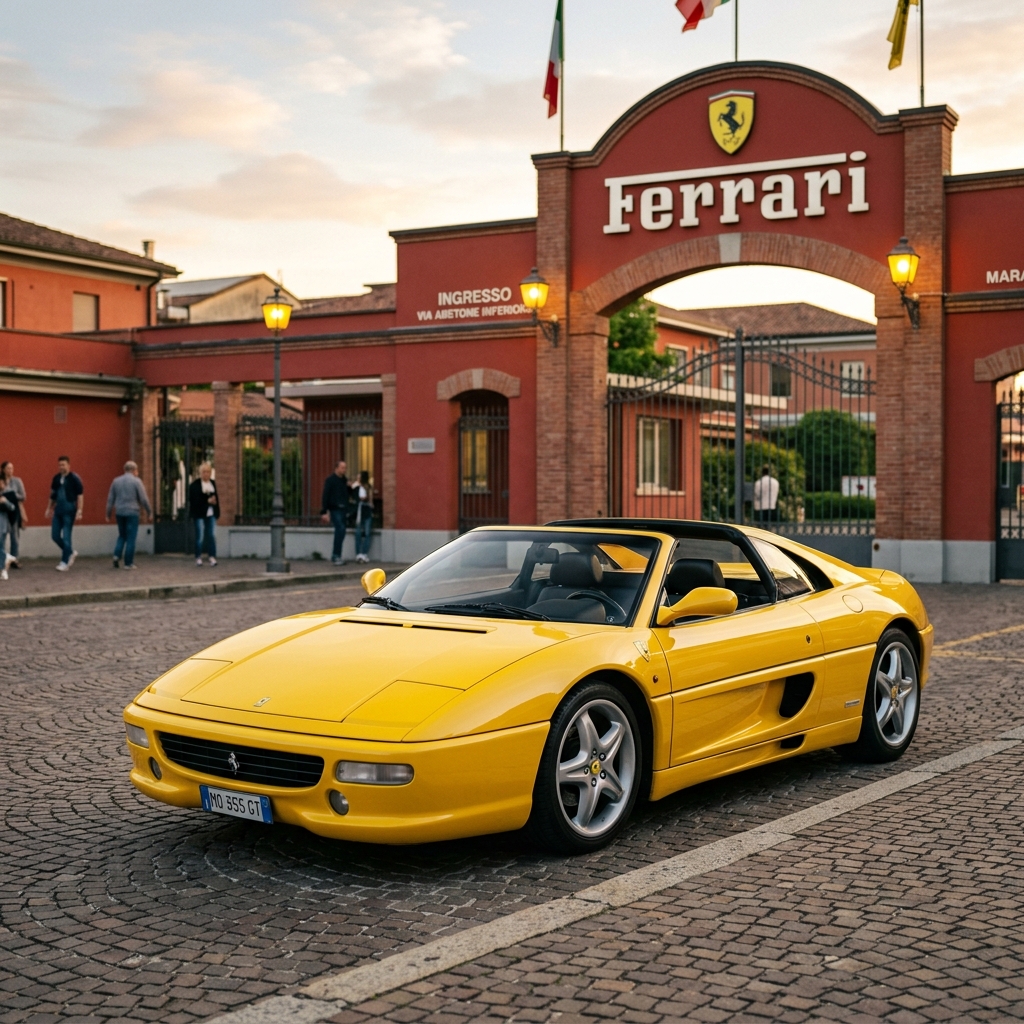
The Ferrari F355 GTS parked in front of the historic entrance in Maranello.
On the Road: A Surprisingly Modern Backroad Carver
Unlike the 348, which could be particularly tricky at the limit, the F355 surprises with its balance and efficiency. Any preconceived notions about the car today—as a finicky, difficult-to-drive diva—are immediately swept away in the first few corners.
When taken out on twisting backroads, the car reveals itself to be surprisingly approachable, stable, and balanced. Its tubular steel chassis with independent double-wishbone suspension at all four corners (and Bilstein electronically controlled dampers with Normal and Sport modes) is a total triumph. The ultra-communicative hydraulic power steering allows placing the front end with millimeter precision.
While the 3.5L 5-valve engine does need to be wrung out in the upper rev range to deliver its best, it pairs perfectly with effective brakes and progressive suspension behavior. The engine-chassis-brake package forms a remarkably cohesive unit. In fact, the F355 is capable of setting a pace on twisty roads that regularly surprises friends following you in modern sports cars.
Furthermore, the car offers a level of ride comfort that is highly appreciable for its class. Thanks to this smooth ride and a spacious front trunk, it is perfectly suited for long weekend road trips as a couple.
Berlinetta, GTS, or Spider: Which One to Choose?
The F355 was sold in three distinct body styles, each possessing its own mechanical and aesthetic personality:
The GTS (Targa)
Historically, this represents the model’s sweet spot, and this is reflected in its values. It offers the structural rigidity and aesthetic purity of a coupe when the fiberglass roof (which stows neatly behind the seats) is in place, while allowing open-air driving at the first sign of sunshine.
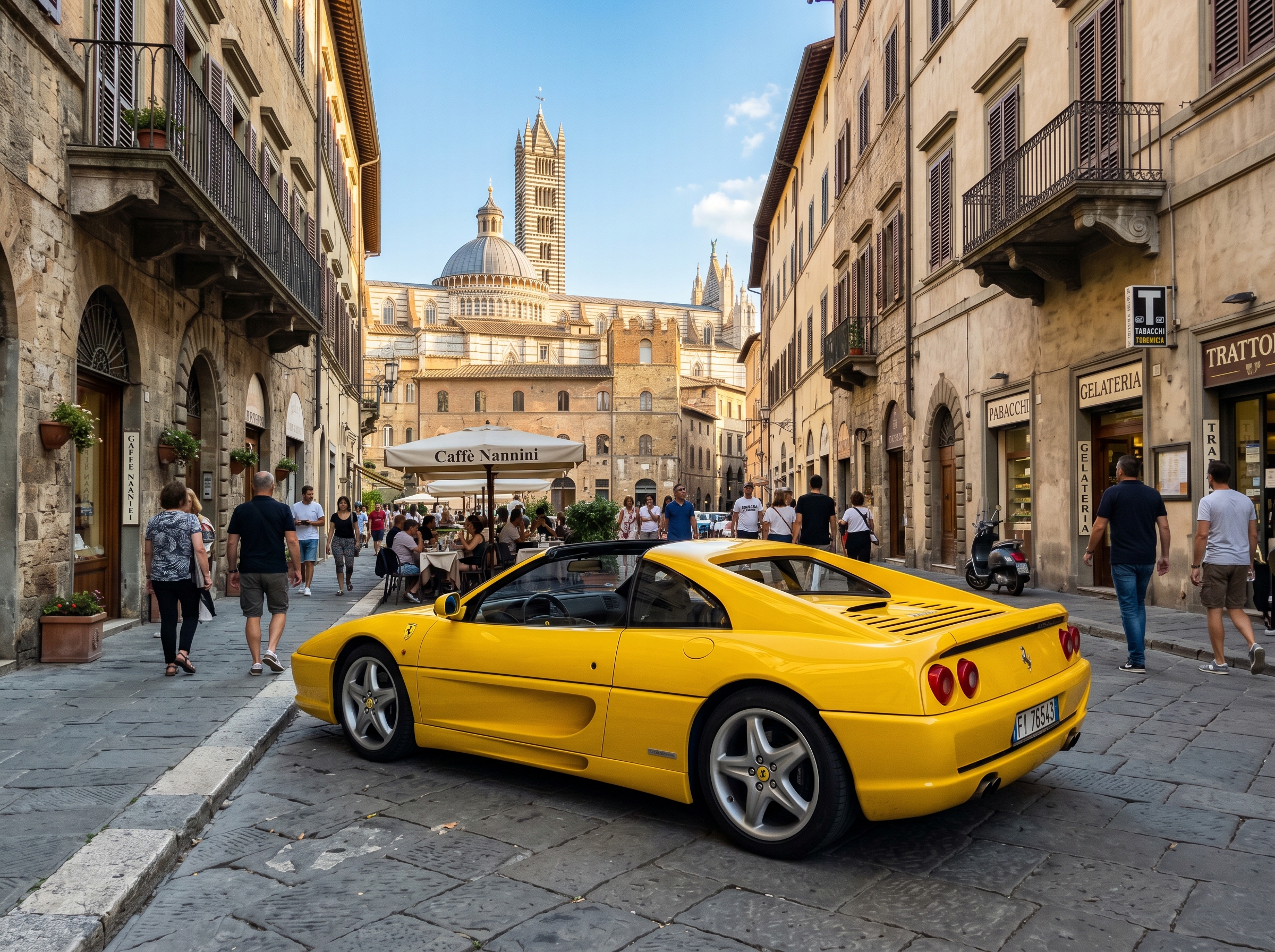
The F355 GTS offers the open-air experience without compromise to the Pininfarina-designed silhouette.
The Spider (Convertible)
Often considered in the past as the least sought-after variant by pure investors due to its less cohesive roof-up silhouette and slightly lower rigidity, it is highly desirable today. This is the version that lets you fully experience the incredible mechanical opera of the 5-valve V8. Driving with the top down near the redline remains an absolute sensory experience.
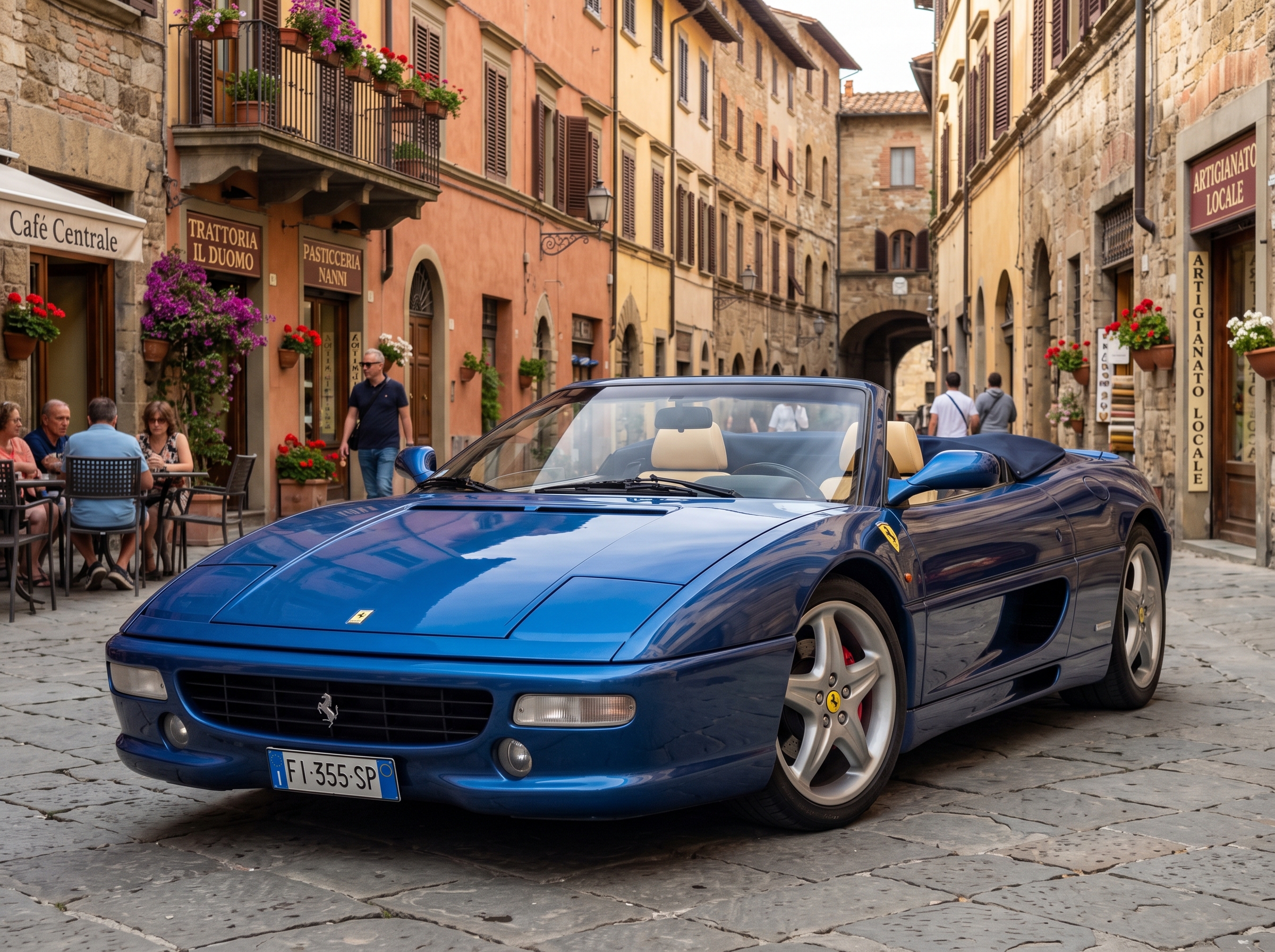
The F355 Spider, the ultimate way to enjoy the legendary soundtrack of the 380 hp V8.
The Berlinetta (Coupe)
This version offers the purest, simplest, and most classic silhouette. It provides the highest structural rigidity and remains the preferred choice of purists and track day enthusiasts looking for the F355 in its original form as a focused sports car.
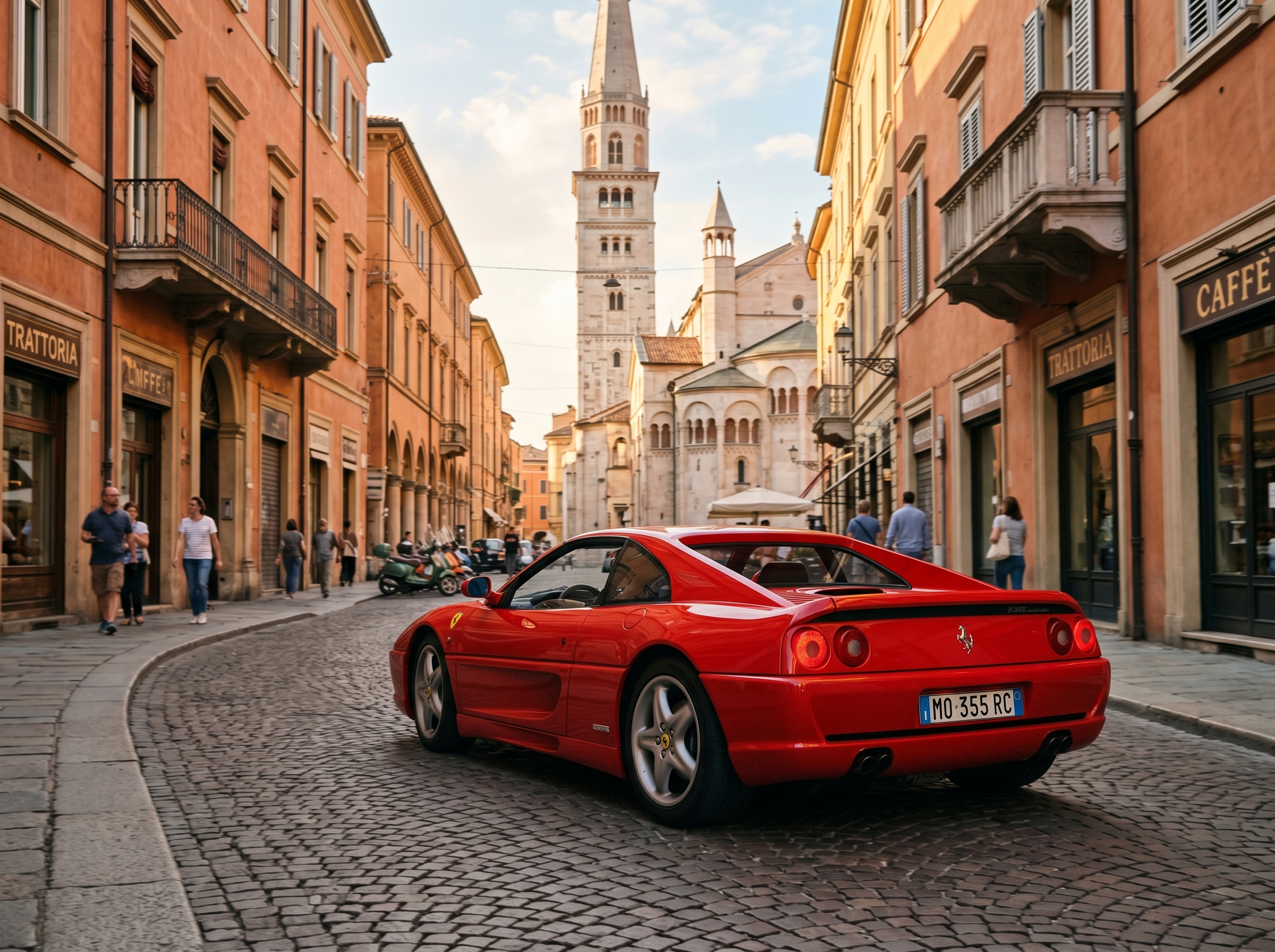
The classic tail of the Berlinetta, Pininfarina’s timeless aesthetic signature.
Reliability: Absolute Rigor of Maintenance
The F355 is a diva that forgives no shortcuts in maintenance. Its original design weaknesses require absolute vigilance when purchasing:
1. Timing Belt and Mandatory Engine-Out Service
This is the model’s most famous maintenance item. Access to the timing belts cannot be done through the cabin; the engine and rear subframe must be completely dropped for the job.
- Recommended frequency: Every 5 years in practice (or 30,000 km / ~18,000 miles).
- Cost: Budget around €5,000 for a standard belt service at a qualified independent specialist. Costs can exceed €8,000 at official dealers or if other components (water pump, seals, mounts, clutch) need replacement at the same time.
2. Exhaust Manifolds
The original manifolds crack under thermal stress, and their internal insulation crumbles. Debris can be sucked back into the cylinders during deceleration, destroying the engine.
- Solution: Check if the original manifolds have been replaced with quality aftermarket stainless steel units (e.g., Tubi Style, Fabspeed).
3. Bronze Valve Guides
On 1994 and 1995 model years, Ferrari used bronze guides that wear prematurely, leading to high oil consumption, blue smoke, and loss of compression.
- Solution: Replacing them with steel guides requires cylinder head removal and adds significant cost (€8,000 to €12,000 during an engine-out service). This is a crucial item to check in the service invoices.
Investment Outlook
The Ferrari F355 market has segmented significantly in recent years, clearly separating exceptional examples from neglected cars.
Rarity by Version (Total Production: 11,273 units)
- Berlinetta (GTB): 4,871 units (3,829 manual, 1,042 F1)
- GTS (Targa): 2,577 units (2,048 manual, 529 F1)
- Spider: 3,717 units (2,664 manual, 1,053 F1)
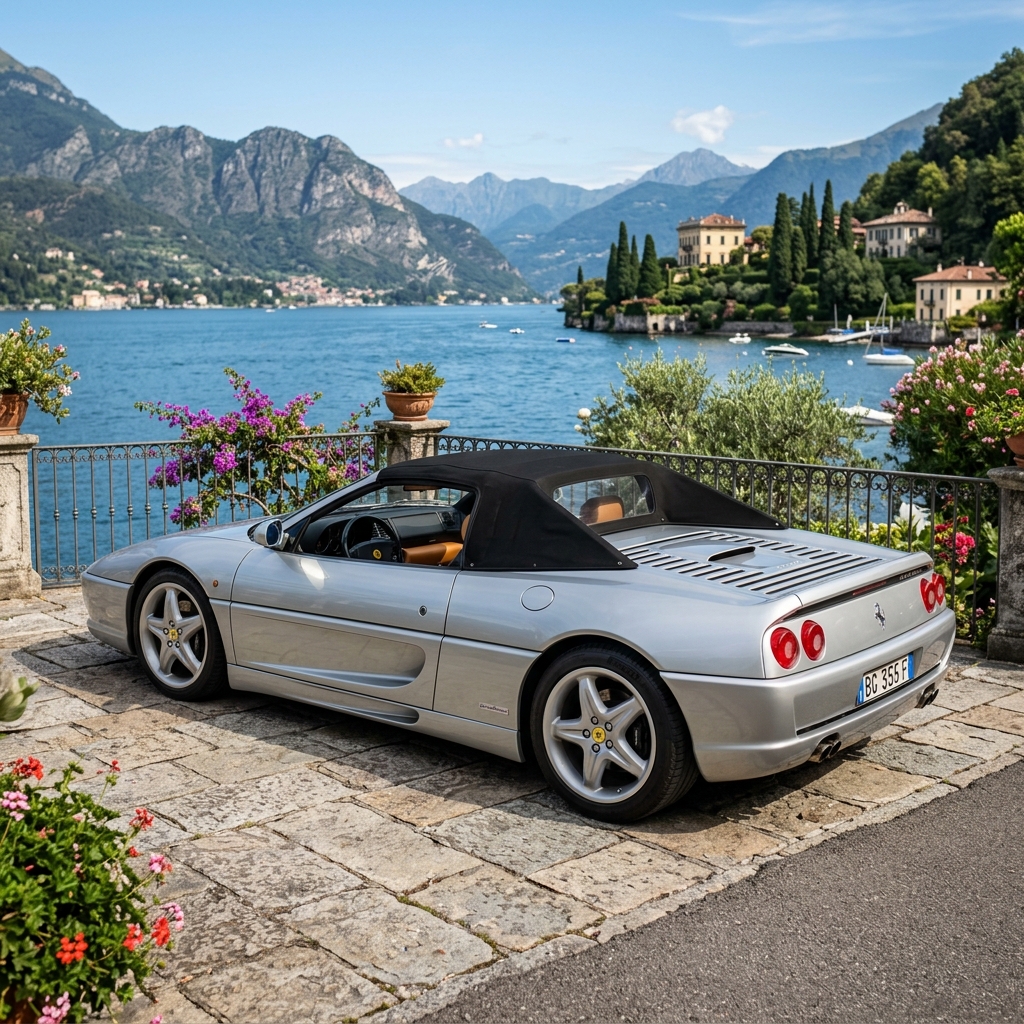
The Ferrari F355 Spider on a terrace overlooking Lake Como.
Market Values and Breaking the “Maintenance Barrier”
Historically, the cost of the engine-out service played a major psychological filtering role on this model:
- The “financial barrier” era (2008-2016): The F355 typically traded between €40,000 and €60,000. At this level, major maintenance represented nearly 10% of the car’s value at an independent shop, and up to 20% at official dealers (€10,000). If the car had unresolved typical issues (valve guides + manifolds), the overall restoration bill could easily reach €15,000 or €20,000—representing 30% to 50% of the purchase price. This disproportionate ratio acted as a deterrent for buyers, pulling values down.
- The recent surge over the last 24 months (2024-2026): Driven by skyrocketing demand for naturally aspirated analog V8s, prices have crossed a historic threshold, now establishing firmly between €110,000 and €160,000 in Europe (and $120,000 to $180,000 in the US) for clean, manual examples—and sometimes much higher for rare colors or exceptionally low mileage.
- Breaking the barrier: With this recent surge, the cost of routine major maintenance at an independent specialist (around €5,000) now represents only 3% to 4% of the asset’s value, and a complete engine-out overhaul with upgrades (€15,000) accounts for about 10% of the car’s worth. Spending €5,000 to preserve a €150,000 asset is now seen as perfectly healthy and logical.
👉 To explore these market dynamics further, we recommend reading our analyses: Depreciation: An Investment Opportunity to understand how to target a car’s lowest depreciation point, and How Poor Reliability Impacts Value which explains how fear psychology shapes resale value.
F355 vs. 360 Modena vs. F430
From a pure investment standpoint:
- The 360 Modena is technically more modern and easier to maintain (belt service access does not require engine removal), but its styling has aged less gracefully and it was produced in larger numbers (over 17,000 units), which limits its appreciation potential.
- The F430 resolves the belt service issue with a timing chain and features a highly reliable V8 of Maserati/Ferrari design. However, its prices are already high and the driving experience is much more filtered by electronics.
- The F355 offers the most spectacular soundtrack, the cleanest and most classic design, and the most analog driving experience. It is the ultimate passion-driven investment, provided the maintenance budget has been planned.
F355 vs. F488 GTB: A 10-15 Year Outlook (The myDriveROI Analysis)
Why compare two radically different cars? Quite simply to illustrate that the F355’s value has not finished rising: in the long run, it will very likely surpass that of the 488, a model that nobody expects to depreciate significantly.
Today, a Ferrari 488 GTB (produced from 2015 to 2019) trades around €180,000 to €220,000—about twice the price of an F1 F355 and 30% to 50% more than a manual F355. But what will the situation look like in 10 to 15 years, when both cars are pure collector pieces?
At myDriveROI, we are convinced that the F355 will surpass the 488 GTB in value within 10 to 15 years. Here is why:
- The end of the numbers game: In the future, nobody will care that the 488 GTB produces 670 hp and does 0 to 60 mph in 3 seconds when compared to the electric or hybrid hypercars of that era. Pure performance numbers always fade before the charm of an era. Only sensations remain.
- Naturally Aspirated V8 Song vs. Turbo Whine: The F355’s 3.5L 5-valve V8 screaming at 8,500 rpm offers an incomparable sound signature. The 488’s 3.9L twin-turbo V8, while efficient, is muffled by its turbines and delivers a much more muted, civilized sound.
- Tactile Mechanical Pleasure vs. Digital Control: The F355’s gated manual transmission requires physical engagement and offers a direct connection to the machine. The 488’s dual-clutch gearbox, lightning-fast but fully managed by electronics, will eventually feel outdated and over-assisted.
- Technological Obsolescence: The 488 GTB is a rolling computer (digital screens, sensors, complex multiplexed ECUs). In 15 years, maintaining these obsolete electronic components will be a technical and financial nightmare. Conversely, the basic electronics of the F355 (Bosch Motronic) are easily repaired or bypassed.
- Pininfarina Purity vs. Aero Styling: The F355 is the peak of classic Pininfarina design with pop-up headlights and clean lines. The 488, while striking, was styled in-house and dictated by aggressive airflow requirements that will age less gracefully.
For all these reasons, we believe the manual F355’s rise is far from over and represents a more solid and rewarding long-term investment than a 488 GTB.
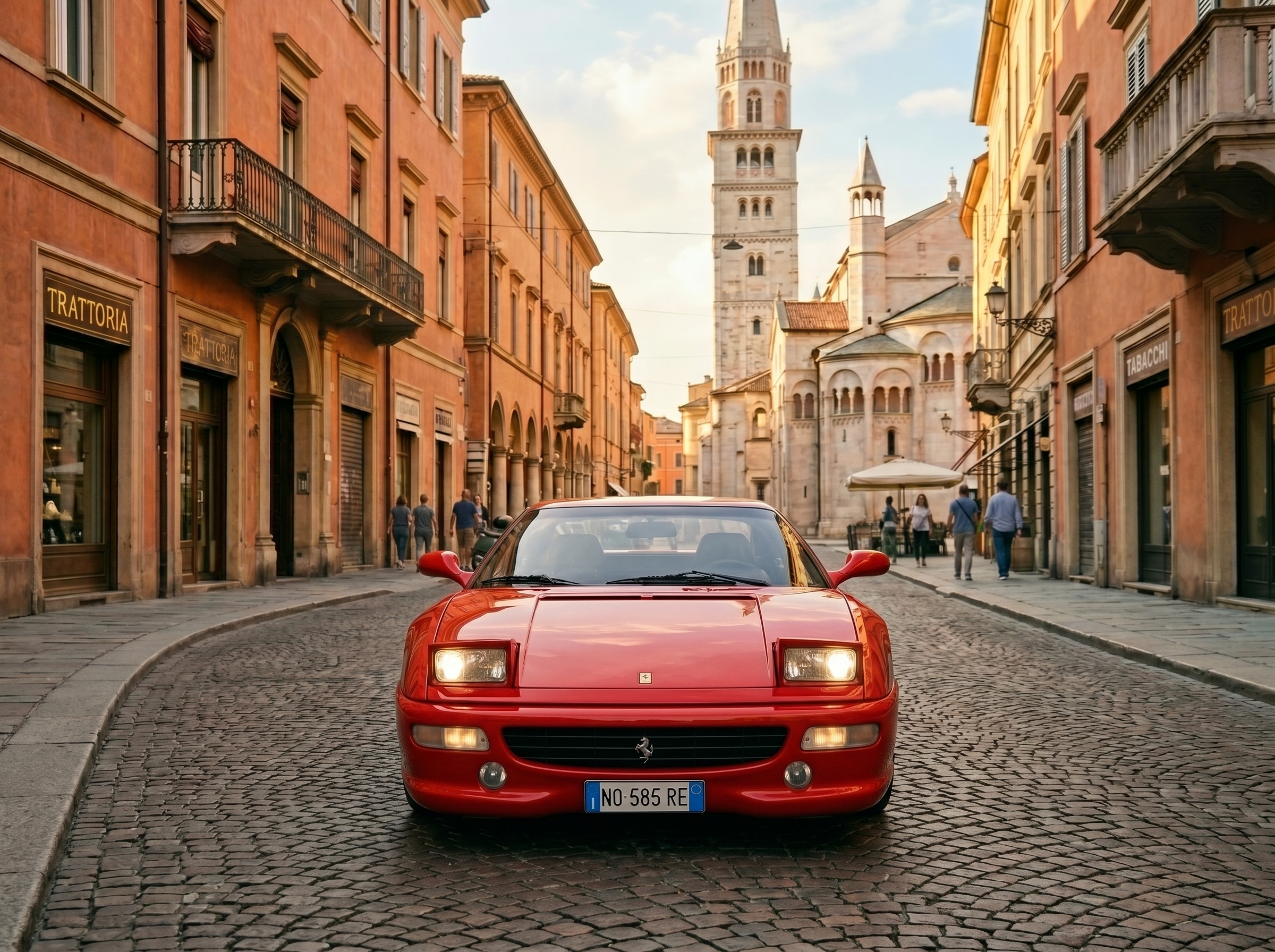
The Ferrari F355 Berlinetta, a timeless masterpiece.
Tips for a Confident Purchase
Purchasing a Ferrari F355 should never be an impulsive decision. The temptation to buy a “cheap” example (for instance, at €75,000) almost always proves to be a disastrous calculation, as sorting out its issues will quickly exceed the price difference of a top-tier car.
- Demand a complete history file: Regular service invoices, inspection reports, and ideally the original warranty book with stamps. Prioritize cars with Ferrari Classiche certification.
- Inspect the latest engine-out service: Belts should have been replaced within the last 5 years in practice. If the last major service was more than 5 years ago, negotiate a price reduction equivalent to the cost of dropping the engine at a specialist (around €5,000).
- Perform a rigorous Pre-Purchase Inspection (PPI):
- Have engine compression tests performed.
- Examine the exhaust manifolds (check for cracks or white thermal insulation powder).
- Check for chassis cracking on the C-pillars (a known weak point on early Berlinettas).
- Verify the F1 gearbox operation: If you choose this transmission, have the clutch wear percentage read via diagnostic tool (SD2) and check if the F1 pump (located in the right rear fender) does not make excessive noise or take too long to prime.
- Prefer long-term ownership: A car that has changed hands every year is suspicious. A passionate owner who has kept the car for several years is more likely to have faced real maintenance costs.
👉 See also: Hesitating to take the plunge on such a demanding Italian machine and prefer to look at another icon in the same budget range? Read our comprehensive guide on the manual Porsche 911 (997) Carrera GTS, a true analog sweet spot combining statistical rarity and outstanding reliability.
Car Evaluation
Evaluation Criteria
Appreciation Potential
Potential for value increase over time
"The F355 represents the peak of Ferrari's transition between the old analog world and the era of onboard electronics. Its timeless design by Pininfarina and the mechanical symphony of its naturally aspirated V8 with 5 valves per cylinder make it an absolute icon. Versions featuring the original manual gated shifter, accompanied by a clean service history and completed updates (stainless steel exhaust manifolds, steel valve guides), have seen a very sharp price increase over the last 24 months and possess exceptional long-term appreciation potential."
Ownership Cost
Total cost of ownership including maintenance, insurance, and running costs
"Historically feared, ownership costs are now rationalizing outside the official dealership network. The inevitable engine-out service to replace the timing belts is done every 5 years in practice, costing about €5,000 at independent specialists. However, the car demands a significant operating budget to address its original weak points (cracked manifolds, bronze valve guides on early model years) and cabin wear (sticky interior plastics). It remains a financially demanding diva but is manageable when maintained by a knowledgeable specialist."
Driving Pleasure
Pure driving enjoyment and emotional connection
"The 3.5L naturally aspirated V8 screams up to 8,500 rpm in an unmatched high-pitched, metallic melody. The dynamic balance provided by the mid-rear engine layout, the razor-sharp precision of the hydraulic steering, and the physical feedback of the gated manual shifter deliver a level of driving pleasure and tactility impossible to find in a modern sports car."
Market Liquidity
Ease of selling when needed
"Liquidity is excellent in both Europe and the United States for examples configured with the original manual transmission and a clear, documented history. Discerning buyers are actively seeking these collector pieces. Conversely, F1 automated manual versions suffer from depreciation and a significantly longer time-to-sell."
Exclusivity & Rarity
How rare and exclusive the vehicle is
"With 11,273 units produced, the F355 is not ultra-rare, but it remains exclusive. The most coveted versions are the original manual transmission models in Berlinetta coupe (3,829 units) and especially the GTS body style (2,048 units). Finding a well-preserved, original, and updated example with a clean history has become a true collector's challenge."
Similar Cars
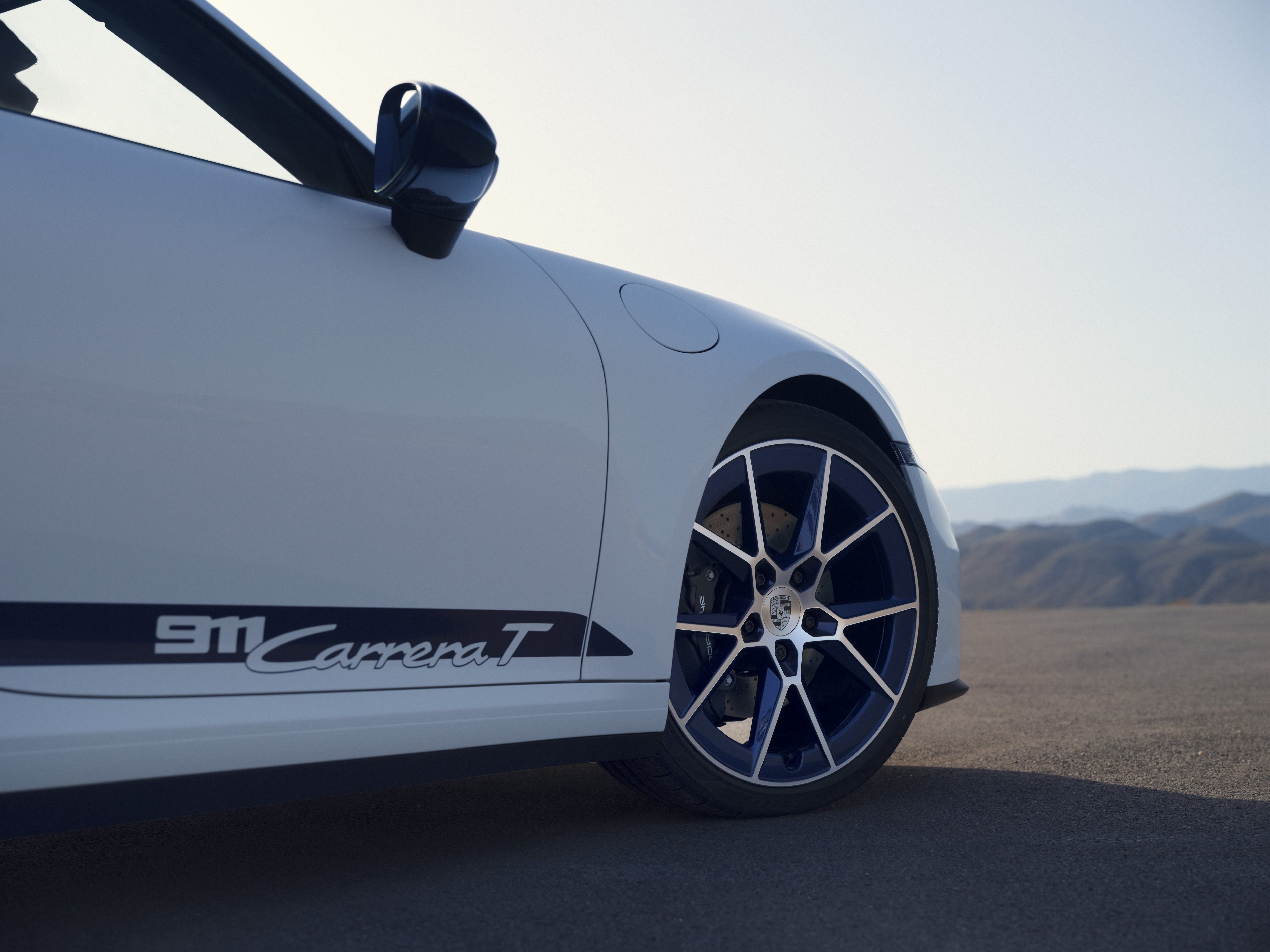
Porsche 911 (992.2) Carrera T: A Brand-New Gem in the Lineup
Porsche 911 (992.2) Carrera T
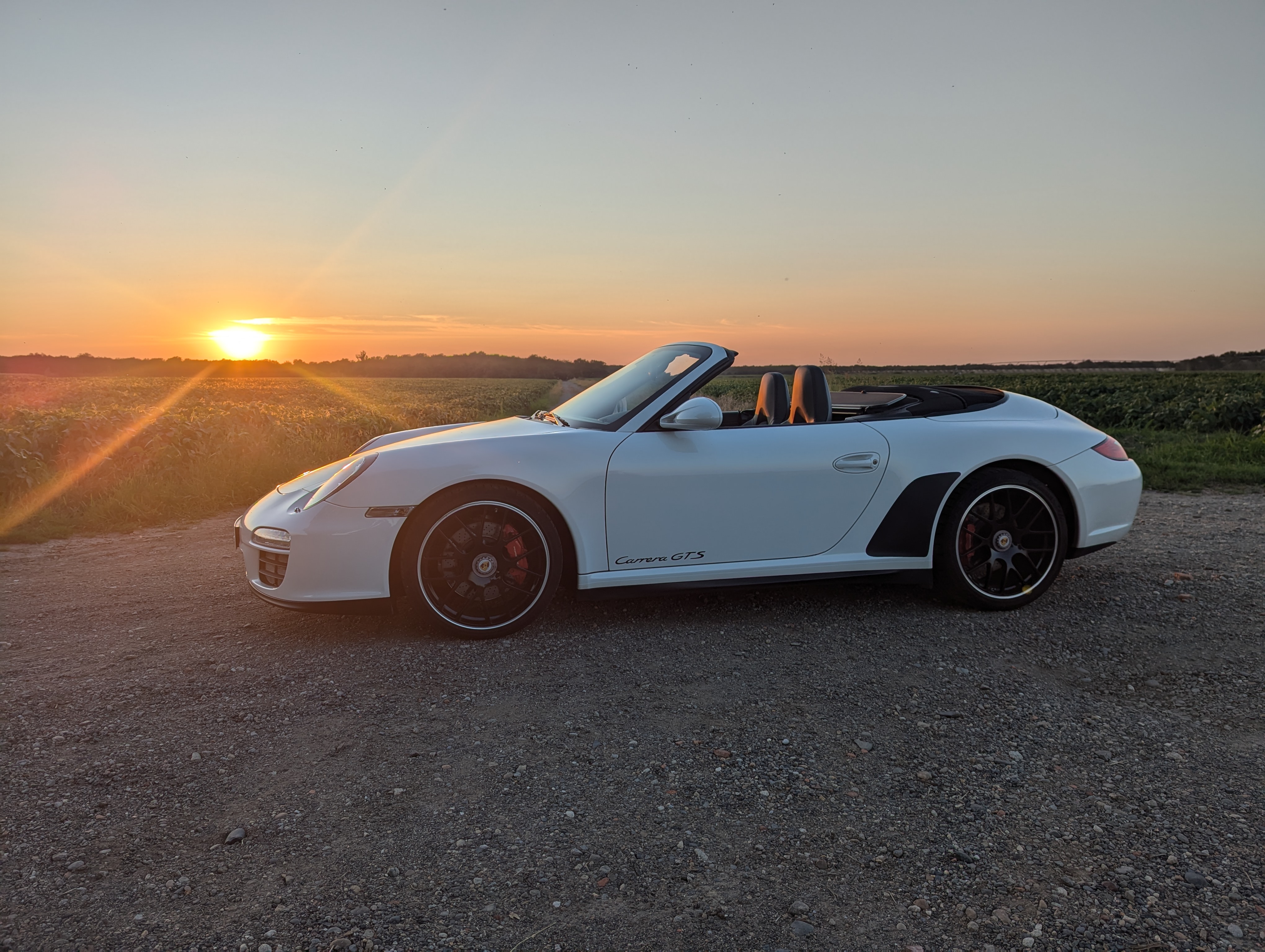
Porsche 911 (997) Carrera GTS manual: The Forgotten Gem
Porsche 911 (997) Carrera GTS
Related Articles